
No doubt a familiar sight to anyone who lives in or has spent a great deal of time around economically depressed city regions. It’s a post-apocalyptic hellhole reminiscent of The Walking Dead or the Dying Light zombie games.
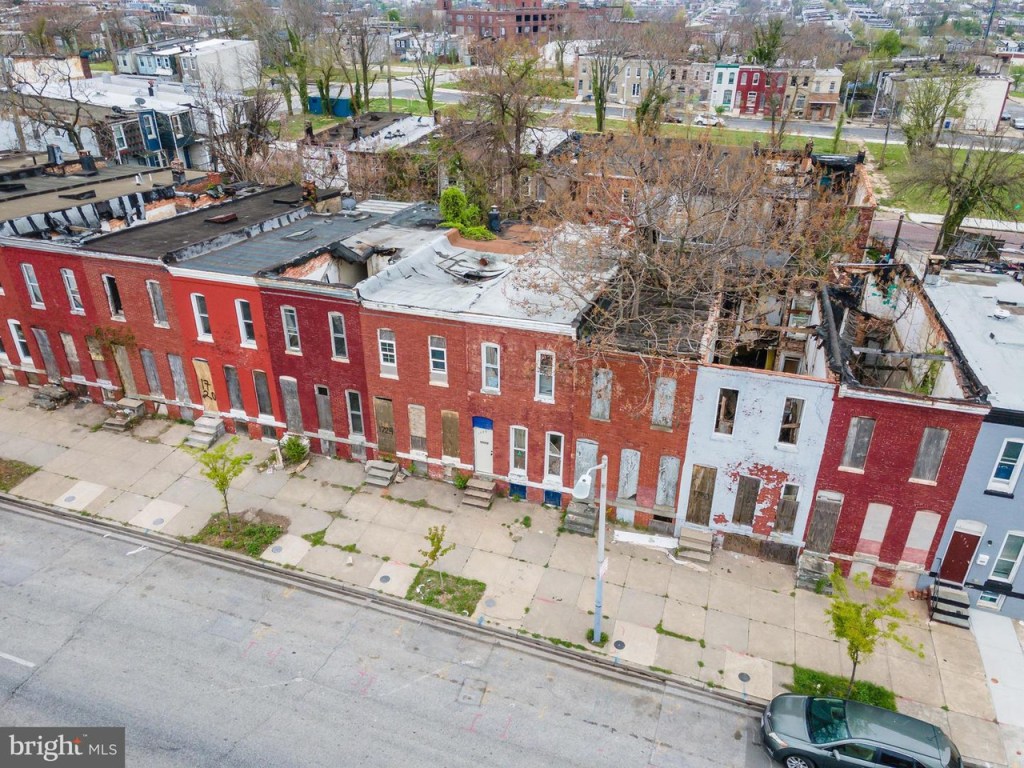
Yet the disease is not a fictitious bacteria outbreak. This form of urban decay comes from impoverished conditions, age, neglect, fires that were either accidentally or purposefully tripped, lack of money for proper upkeep or crime. Or a dreadful combination of them.

Often the title ownership to left-for-dead rowhomes like these in Baltimore City are transferred so frequently like a hot potato it gives the real estate phrase “flipping” (as in turning around an investment property in quick succession to another buyer soon after an initial purchase) a bad name. Especially when no money gets put into the investment property, resold at a marginal profit “as is.”
Every time I see one of those “flip that house” shows on t.v., it reminds me of a time when the business act was once illegal in the state of Maryland. Not that it stopped seedy investors and cash-grab title companies. This is the business I work in by day, 27 years’ worth. I’ve seen it all and continue to do so even today. It’s a trade not for the weak.

Imagine trying to parkour across caved in or in many cases as you see here, thoroughly wiped-out rooftops. In the few cases of city rowhomes which have benefited from upkeep, being forced to co-exist with ramshackle garbage which may or may not have been properly deemed as condemned has forced, along with Baltimore’s insane crime rate, many folks to move out in a mass exodus. This has forced a lot strain on the city’s suburbs.
Then again, we have seen a large uptick in city rehab investors buying these decades-old properties on the low end and many of them actually doing the right thing, sinking proper uplift funding through time-spread rehab escrows. Taking the time to reinvest, remodel, apply for the appropriate use and occupancy permits, turning junk into jewelry. While I’ve seen rise and demise after rise and demise inside the standard residential mortgage industry (a cyclical business from which I’ve both thrived and been downsized too many times), right now hard money lenders and privatized funding operations are giving life to a prolonged hard season inside the industry.

Perchance to dream rotten core shells like this seldom few venture into may yet again have a chance to breathe…
–Ray Van Horn, Jr.
 Roads Lesser Traveled
I grew up near one of those kinds of neighbors. It can be heartbreaking.
LikeLiked by 1 person
I can tell you’ve have a hard urban life. Your writing speaks of it.
LikeLiked by 1 person
Not as nearly as hard as many, but it was no walk in the park either.
LikeLiked by 1 person
Fair enough!
LikeLike
This hits a nerve with me – It seems so irresponsible on the part of municipalities to let this happen. How is it we build all these new, shiny buildings and ignore the decay?
LikeLiked by 1 person
I know. There have been city initiatives for big league investors who have actually spiffed up sections of town and the communities have changed dramatically. However, they are mere sectors in comparison to the overall perspective. Kind of like NYC, you can be one cosmopolitan block, then the next one, a hot mess. I applaud all the interest of the private investors, the ones who bother to renovate, at least.
LikeLiked by 1 person
Toronto is like that too. Our cities are decaying and still they are tearing up fields. Sad state.
LikeLiked by 1 person
Yeah, I suppose poverty is poverty, no matter your country and a blind eye gets turned just the same. I agree with you tearing up new land for new projects, but it’s all perception. Neglect and decay and especially a criminal element spells bad investment. There are courageous rehabbers, but you just can’t get enough interest when theft, murder and violence, even general mayhem, are a turnoff to residents, much less investors.
LikeLike
Thousands of homeless people on our city streets come to mind when looking at these images.
LikeLiked by 1 person
Exactly. Baltimore’s homeless are there, but often pushed out of view until 9:00 pm. Then they’re in sight everywhere. Just sad.
LikeLiked by 1 person
I had a feeling that was going to be Baltimore. Reminds me of some of the areas where “The Wire” took place, e.g., “Hamsterdam” …
LikeLiked by 1 person
Spot-on, man! Sadly, The Wire ended up being prophetic. Baltimore was rough then. Now…our sports teams keep the city in any kind of relevance.
LikeLike
I too remember the days when flipping was illegal – last I heard, FHA wouldn’t finance a “flip” for a certain amount of time. That said, it would be so wonderful for our governments to assist in rehabilitating some of these areas the proper way. Developers will still get their money, and the cities would benefit greatly. Guess my common sense just kicked into overdrive…
LikeLiked by 1 person
Indeed it did! Someone had to say it!
Yeah, it would be anywhere between 3 to 6 months depending on the loan program and even in one county in Maryland, Prince George’s, they will tax you extra transfer if you refinance within a year of buying.
Flips still make me sick to look at, but I’ve been in the business for 28 years. You see it all, it never gets palatable.
LikeLiked by 1 person
Fascinating. As a left-coaster, this kind of urban decay is a little alien to me. The residential equivalent in places like Oakland (California) is older single-family homes, almost always still occupied in one fashion or another. I doubt anyone would bother to flip, or even rent one due to a combination of crime and state regulation. Non-corporate property investors from California move their money out-of-state these days.
In this state (Nevada), since the 2008 banking collapse, most counties have required that there’s at least one year between any significant owner renovation and a sale. That even applied to me owner-supervising the re-roofing my own home.
In Japan, abandoned houses, or “akiya”, are pretty common, and can often be purchased for the taxes due on them. But nobody would look at one as an “investment”.
LikeLiked by 1 person
This city is stocked with private investors using hard money lenders vs. standard financing banks. Higher interest rates for shorter terms. They’re buying and flipping, either at a quick buck profit, or they’re taking rehab escrow money in their loans, fixing the properties up and selling at a much tidier profit. A lot of these people end up refinancing in a hurry with these hard money lenders so they have time to do the work. Or they abandon ship and sell.
Even nuttier are contract assignments and that’s a heavy load of what filters into my current office. Essentially laying down the initial contract, then finding a new end buyer to pick up the contract with a set price to assigning it, a “finder’s fee.” It gets problematic when the title company loses track of who the end buyer is, but sometimes these folks get shifty and don’t tell us when a new buyer has been set. I’ve seen a recent file with 4 different buyers on the same pass-along assignment, and of course the fourth one, nobody bothered to tell us until settlement day came.
Baltimore has gotten as violent as Chicago and crime ridden as Oakland. It’s a tough city to live in, so you’re seeing all these abandoned homes with squatters living in crap shacks like I’ve posted until an investor comes along to buy it and the fight is on to evict them. It’s insanity.
But how, the “akiya!” Baltimore has a similar process with tax sales, and we see a ton of those. Same idea, but you’re rarely seeing someone buying the property lost to taxes making it their home. All investment.
LikeLiked by 1 person
There’s so much I could say about this but I’m not about to get myself into trouble today. It’s an excellent blog you’ve done, thanks.
LikeLiked by 1 person
LMAO! I understand where you’re coming from and feel free to speak your mind here anytime. Thank you so much for your kind words.
LikeLike