Yeah, I’m a Cobra Kai fan and I can’t wait for Season 6 to drop at Netflix, even if that means the end of a gonzo karate soap opera that never should have worked but worked like a charm.
I loved the first two Karate Kid films as they came out, while Karate Kid III had some great baddies despite clumsy execution and a real drag of a plot. If anything, Ralph Macchio’s Daniel LaRusso turned the same Rocky premise into its own franchise into something more relatable for teens of my generation. What he and William Zabka created later, with danged near everyone of importance to the Karate Kid films (aside from the late Pat Morita) is pure, nostalgic Hollywood magic, bridging to a new school cast up to the task. Cobra Kai has been a drug for me and again, it’ll be sad to see it conclude.
I have the scores for first two Karate Kid flicks and the first five seasons of Cobra Kai, I’m that immersed into the experience. I also have the side CK soundtrack of regular songs, which are half gooey fun and half cringeworthy. All indicative of the 80s pop effervesence in which they made.
Hearkening back to the original film, here is Joe Esposito’s memorable rally song spinning through Daniel’s LaRusso’s improbable decimation of the Cobra Kai team who has been tormenting him all movie long. My generation was found walking around singing this peppy number because it does carry a sense of stride and a sense of pride. Even Johnny Lawrence, showing momentary good sportsmanship at the end of the first film when losing to LaRusso for the All-Valley championship, can take a song like this and run to the top with it. He was the best…around. Still is.
No coincidence I should find, while reading a handful of retro Godzilla comic books from 1977, released back then by Marvel, this ad. For what appears on the face, to be another beastie (this time from the depths) socking humanity upside its arrogant choppers.
First takeaway, those Godzilla comics fetch a hefty bit of coin these days and for fun, I’ve been checking out a few local comic shops to see what, if any, have available for sale on the brick-and-mortar circuit. With the runaway successes of Godzilla: Minus One and Godzilla x Kong: The New Empire, it should be no surprise I found but one Marvel Godzilla comic out there, one I didn’t already own and keeping a tuckaway gift card for such occasions, it came home with me. You want these bad boys, the IDW imprint Godzilla books (or anything Godzilla-related), you’ll be doing much of your hunting online and be prepared to pay. The look on two of those comic shop owners was priceless as I faked being some clueless newbie asking around for Godzilla merch. I wanted to see what I already knew. Other than t-shirts, the big G is really tough to find in the open-air market. Godzilla is hot right now, point-endpoint.
Next, we come to this movie, Orca, also from 1977 and I remember as a kid reading comic books how goddamn impressive, how goddamn scary this movie looked by the movie art alone. This ad came up so often in my comic stash it’s a wonder I didn’t beg the snot out of my parents to take me to see it. The only explanation being Star Wars: A New Hope had come out the same year and nothing ruled my life harder. Kiss, The Electric Company and baseball behind that.
Now, if you’re sitting there thinking this revenge tale of a killer whale having the cognitive wherewithal to go serial killer mode (or at least oceanic Bruce Lee style) upon a Nova Scotia waterfront town is batshit crazy, you’d be correct. Moreover, targeting a ruthless Irish Canadian sea captain and his crew who killed his mate is not only a Jaws and Moby Dick wannabe, then ding-ding goes the dinghy of familiarity.
The movie poster made Orca look more epic than it was, similar to the 1977 King Kong remake poster that was ten times more formidable than the final product. Paramount Studios had a big year in ’77 and the movie posters to prove it.
Orca is a bit of a mess but worth at least one watch if you don’t expect it to live up to its pitch. There was no technology other than cable wires difficult to hide (there was no computer airbrushing at the time) to recreate the visceral sight of a harpooner taking his likely final mortal shot in midair. Instead, this film submerges us into the appalling premise of a captain so hellbent on retiring with a healthy payout he turns on another orca saving his crewman from the great white shark he’s been pursuing for a local aquarium.
Skewering the pregnant female mate of our titular killer whale turned apex predator, then dumping the miscarried fetus overboard is about all you can stand from this movie produced by the legendary Dino De Laurentis and featuring a hefty cast including Richard Harris, Robert Carradine, Charlotte Rampling, Will Sampson and even Bo Derek. Effective enough in creating sympathy for an aggrieved whale and less for Harris’ Captain Nolan, considering he too has lost his wife and child, but it’s up to you if you want to hang around to see this thing play out its icy finish at the Strait of Belle Isle. Reportedly Richard Harris insisted on doing his own stunts in the polar-bound finale and nearly died a few times.
That harrowing bit aside, Orca is a classic case of marketing prowess with its product coming up well beneath the hype.
Probably THE happiest song I’ve ever heard, Miss Maxine Nightingale’s stomp-and-clap soul-pop perfection, “Right Back Where We Started From.”
Too bad Maxine was considered a one-hit wonder, but Pierre Tubbs and J. Vincent Edwards gave her a monster groove and the most upbeat message in 1975 of rekindling love with optimism of the deepest conviction before it fades out together. I often wonder if my late Aunt Maxine (a Caucasian woman) was a huge fan of the song, since her hair was, to her dying day, modeled in the precise sculpt as Nightingale’s.
Fans of the hockey comedy Slap Shot (one of the most hilarious romps in cinematic history) will no doubt be thinking of the Hanson Brothers, Paul Newman and Charlestown Chiefs road dogging scene segues criminally replaced on the VHS version with some awful schlock not worth mentioning. No doubt in a scrum of its own at the time for rights to use “Right Back Where We Started From.”
Fortunately, DVD and streaming have rectified this gratuitous error in thinking.
For the longest time, my most favorite song in the world. I can see my young self bouncing all over the living room when this song was out and asking my parents to turn it up whenever it came on the radio while in the car. This lip-synced clip was broadcast on the Dutch music variety show Toppop (not to be confused with the UK-based Top of the Pops), though you can dig up an even cheesier video attributed to the same show of Maxine swaying around in Seventies’ glitz hovering atop a golden ocean and surrounded by a deserted island and a hysterical gliding shark fin. It was the 1970s. You had to have been there.
Try to leave this blog in a bad mood after spinning this infectious number. I triple dog dare you.
Christmas of 1987, my folks gave me this exact cassette rack, but even more holy crap worthy, it was three quarters filled with (then new) metal, punk and rock cassettes I’d wanted. Blew my 17-year-old mind, I tell ya. My parents have always been the best.
Of course, cassette tapes were a bane of their times, though nothing like 8-track tapes during the 1970s. You’re really telling your age if you know what I’m talking about there. 🙂 I lost so many cassettes from splitting or gnarling up inside the spindles of tape decks it’s cringeworthy.
Albeit, I wish I still had my box of cassettes I’d recorded hundreds of band and film director and actor personalities on. A gold mine from my past I’d love to hear again, no matter how long it would take to spin them all again.
While I’m in an EC Comics frame of mind this weekend, let’s talk about everyone’s favorite illustrated satire magazine, Mad.
Originally released in 1952 under the EC banner by Harvey Kurtzman and William Gaines, the original incarnation of Mad was written almost entirely by Kurtzman and it had a far different look and attack plan than what most people know it for, if still slinging its trusty brand of shenanigans straight from the gate.
After 24 issues at EC, Mad shifted its tone, artistic vision and blazing lampoonery toward roasts of pop culture, movies, t.v. shows, politics, sports, consumerism, sexuality and society at large. Moreover, the new order of Mad birthed a flagship mascot who has endured and schlocked each cover for seven decades, the gap-toothed lieutenant of lampoon, Alfred E. Neumann. “What, me worry?” being Alfred E.’s call-to-arms for all knuckleheads at-heart.
Iconic creators who any Mad habitue can roll off their tongues like Al Jaffee, Sergio Aragones, Dave Berg, Don Martin, Mort Drucker, Frank Jacobs and Antonio Prohias came along in the mid 1950s with the shift in editorial leadership from Kurtzman to Al Feldstein. The 1960s through the 1980s was the most prolific time period for Mad, and no glittering personality was safe. Some had the sense of humor to embrace being tomahawked by Mad’s “usual gang of idiots.”
Heralded as Mad magazine’s proto pantheon (along with artist Will Elder from the roots of the magazine), no creative team since has been able to match these juvenile delinquents of parody. Well, maybe Tom Bunk has a case. So glaring is the fact that Mad continues to reprint its classic pages from these artists and writers, not merely in the countless double-sized “special” compilations, but also since pulling the wool over their readership’s eyes by announcing the magazine’s finality in April of 2018. Only to hoist the same marketing trick as comic book imprints themselves, rebooting and resetting at a new volume Issue # 1 that same year. Dirty pool, but that’s the name of the game in the funny book business these days.
I’ve had in-and-out love affairs with Mad magazine, about which William Gaines himself is once quoted as saying “We must never stop reminding the reader what little value they get for their money!” while issuing the caveat to his audience of thinking for themselves. When I’ve gotten on Mad benders at different times in life, I’ve sat there chuckling the hardest at Spy vs. Spy segments (even under threat of tickle torture, I’ll never tell which one I’ve rooted for all my life), Don Martin’s one-pager cartoons of buffoonery, Dave Berg’s always insightful “The Light of Side of…” and anything Al Jaffee wrote or drew.
Especially his essential “Mad Fold-Ins” that I learned to develop a soft touch with so as not to violate the minting of the book. Sorry, that just comes from having worked in comics retail during the early 1990s. Even when there were gloriously sinful boobies molded from those maniacally brilliant fold-ins. Jaffee, more than anyone pushing the envelope with snot, barf and pimply bare butt gags in Mad, went there whenever he could get away with it.
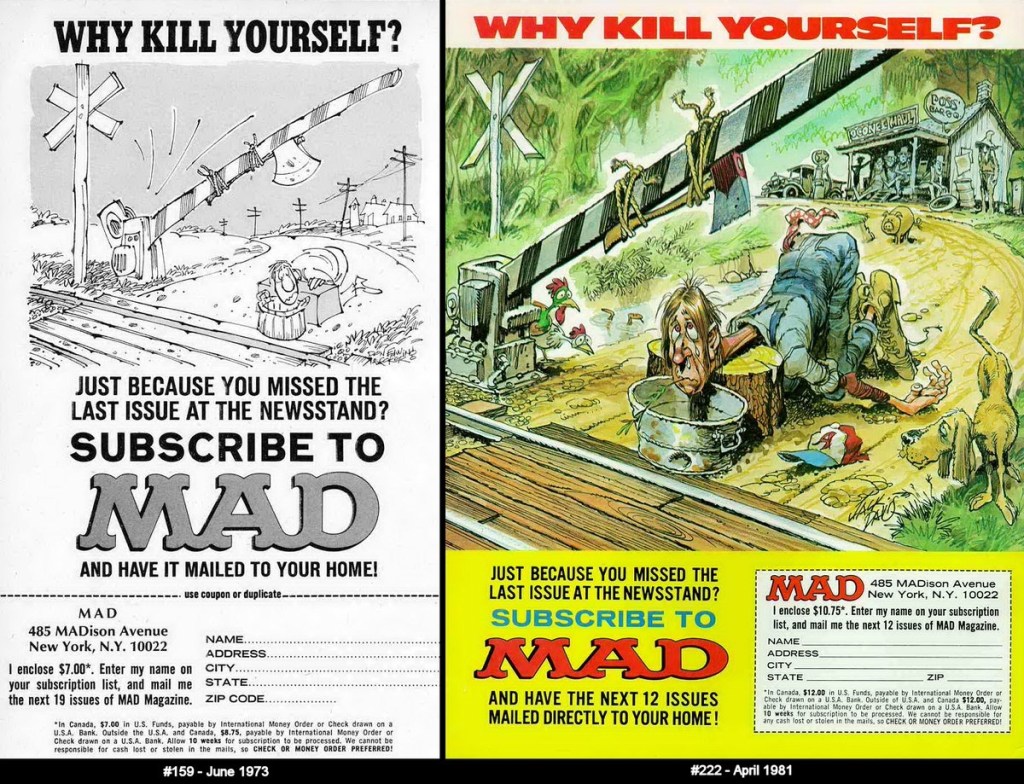
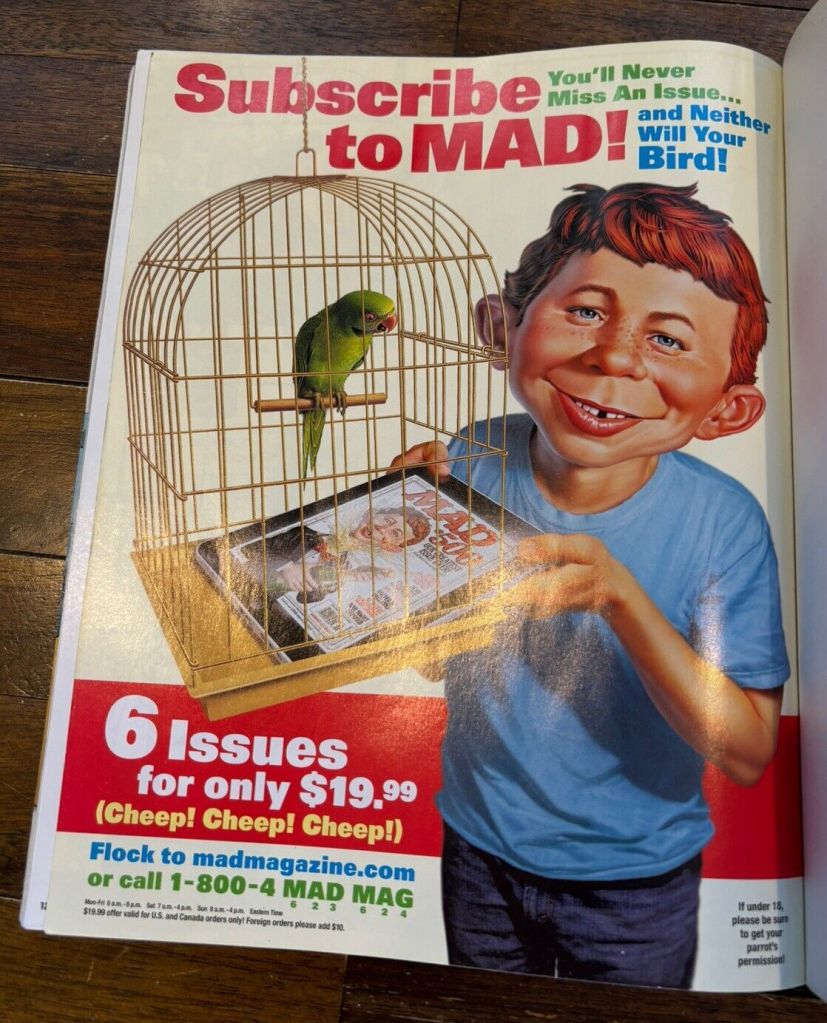
I’ve twice had subscriptions (definitely the best way Mad can validate its claim of “Cheap!”) and I’ve enjoyed passing them back and forth with my stepfather, who, like me, has read the magazine in sporadic chunks of years, but also like me, ravenously while dug in. As a teenager in the 1950s, he was there in the beginning of Mad and let me tell you something; I never saw such joy in a man’s face when I brought him a copy of Mad’s 2024 Free Comic Book Day torching of DC Comics superheroes. Same as my birth father, who’s deadly accurate hand-drawn recreations of Don Martin’s bubblehead dolts were amongst his proudest achievements outside of model railroading. One of his clients for a commission piece being none other than Rod Stewart.
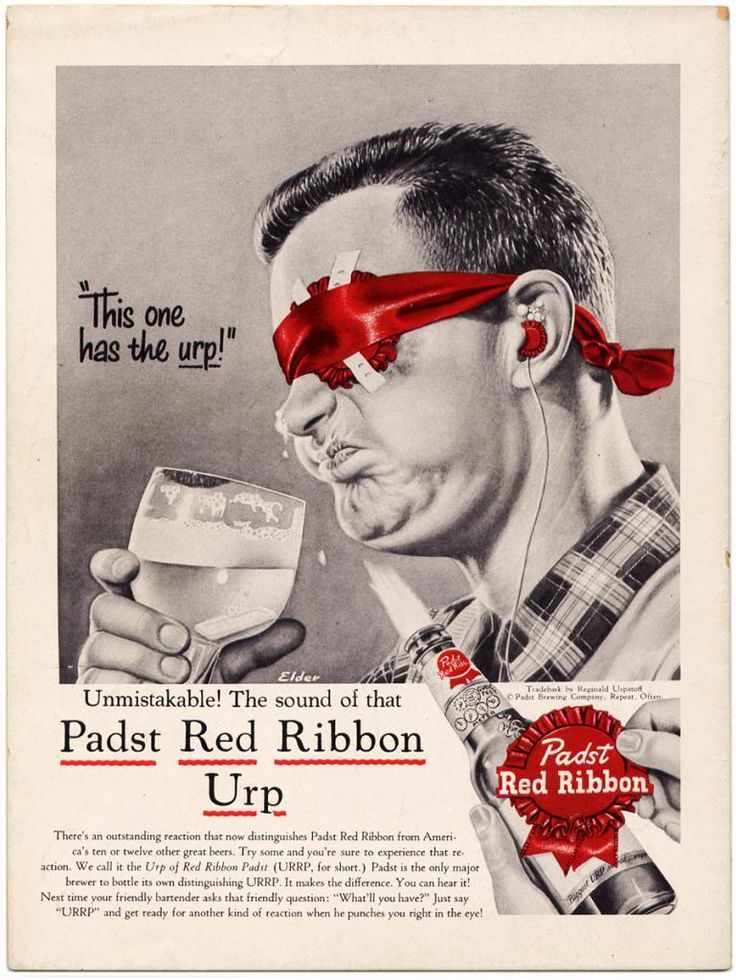
These ads plugging the magazine itself are a riot, but anyone who’s a longtime Mad buff will attest the magazine was lauded for its specialty in goofing on existing products with the same expert adolescent trash humor as Wacky Packages stickers, which used to rule my life from ages 9 to 12. Sometimes Mad got downright uncomfortable decades before the age of cancel and political incorrectness. An example being the model’s penchant for young boys in Mad’s “Clairold” hair product spoof, which was hilarious once, nowadays a one-way ticket to the sex offender registry.
This classic dish on Pabst Blue Ribbon beer (no coincidence, my stepfather’s go-to brew) is probably my favorite Mad ad pasquinade ever. Urrrrrrrrp!!!
As mentioned in a prior post, one of the most figurative media which influenced my writing and continues to do so today is the once-maligned, now celebrated EC Comics of the 1950s.
This is the same comic book imprint famous (or infamous depending on your tastes) for releasing the original Tales from the Crypt horror comic series which became a mega hit in the 1990s as a televised adaptation for HBO.
If you’re really paying attention to the show’s seven seasons, you’ll note not every story aired was a Tales from the Crypt original tale. The show culled many stories from EC Comics’ other brands like Vault of Horror, The Haunt of Fear and Shock SuspenStories. I won’t bore you further by delving deep into the British horror film company Amicus, who had their more moderate (but nonetheless creepy fun) short story compendium films for Crypt and Vault during the 1970s.
What I will mention briefly is that EC Comics (acronym for an “Entertaining Comic”) came under fire from the United States government during the McCarthyist paranoia of the 1950s for their garish, sometimes gory depictions of horror-styled comeuppance. Leading to mass comic book burnings helmed by the conservative propagandist Frederick Wertham’s publication of Seduction of the Innocent used by the Senate Judiciary Committee. EC Comics, ironically enough, originally started publishing mainstream romance and Christian-based comics. Funny to think of the Senate’s staking the claim of EC Comics breeding youth of the 1950s into hedonistic mass murderers. Killing in the name of Nikita Khruschev, of course.
Paltry sales then pushing EC to go more hardcore (for the times) in their horror comics, Shock SuspenStories may have been tamed down in the gore department, but the series still pushed mind-alerting stories (also in their sci-fi comics like Weird Fantasy and war lore, Two-Fisted Tales) filled with a repetitive cheaters-will-get-theirs motif.
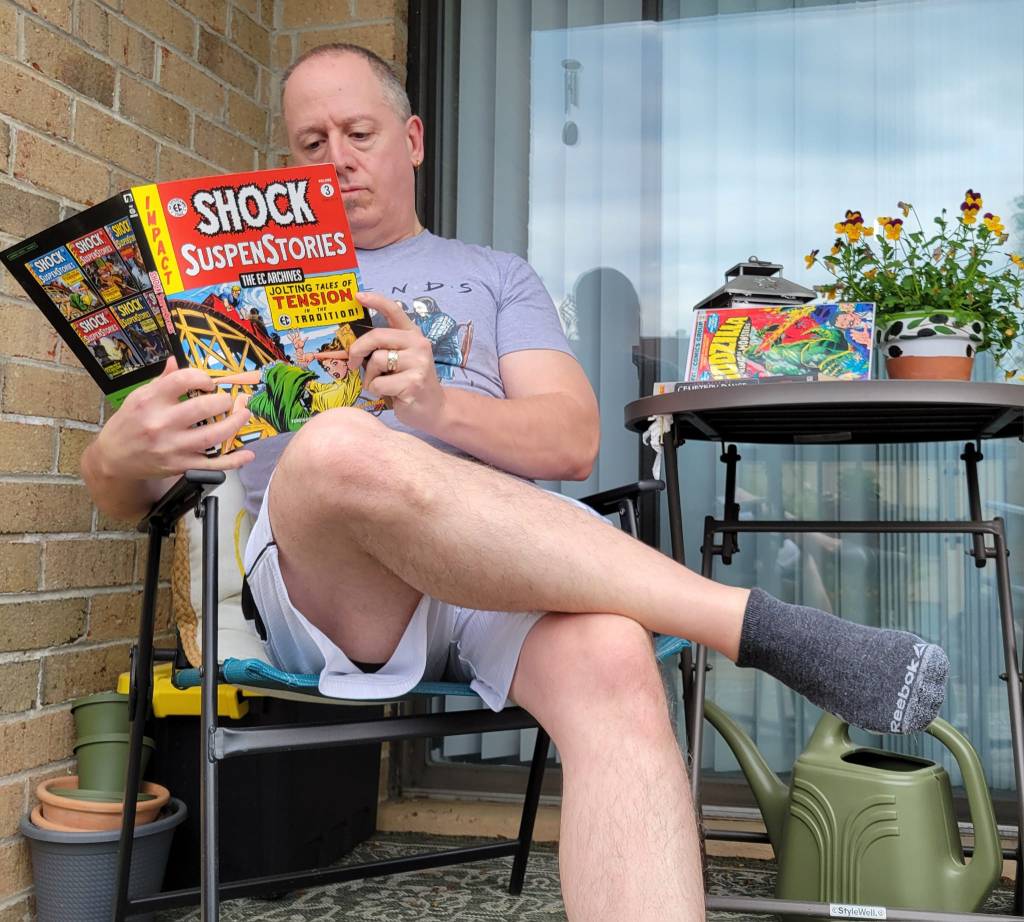
I was going through my EC reprint collections (alas, I only own two original ECs in my massive comic collection), this morning and forgot how daring Shock SuspenStories issue number 13 was, which leads off with the HBO-adapted “Only Skin Deep.” For me, the second tale of the four in this issue is the most riveting and the biggest challenge to the system which may have added to the spark of monomania when it was published in 1953. I told TJ, who was lying next to me in bed, how blown away I was by “Blood-Brothers” as she woke upon my hitting the final page of the story.
Let me quickly summarize this genius-level storytelling coming during The Fabulous Fifties, which, facing the facts if you have direct experience or were raised by the generation, was fabulous more for Caucasian males than any other demographic of the decade. There was a reason things came to a head the subsequent decade with the Civil Rights Movement.
“Blood-Brothers” focuses on a bigot by the name of Sid who has engineered the death of his neighbor, Henry, who happens to have a mixed-race lineage in his bloodline. All beforehand, Sid has accepted Henry as a friend and an equal, but when another neighbor puts his house up for sale and the leading applicants are a family of color, Sid begins a crusade of hatred leading to Henry’s suicide once Henry has made his family history known.
I’ll let you read the details because this story deserves your attention, even if you could care less about comic books. The punchline is the proof in the pudding where the coroner attending the police scene following Henry’s death reveals the exposition of Sid’s own life as a child depending upon the blood transfusion type match from an African American male.
Making the point, rebellious for its time, that it’s not skin color which differentiates us when our lives on the line, but blood type. In this case, a racist who plants a burning cross upon the lawn of a former friend he’s taken painful measures of destroying his life, having been literally saved once by a black man.
I can only hope McCarthy and Wertham have found bigger enlightenment in the afterlife all these years.






 Roads Lesser Traveled