Getting Our Wine On at Dodon Vineyards – Davidsonville MD

What a wonderful post-wedding gift from my stepdaughter, a tour and tasting session TJ and I enjoyed at a hidden gem stashed in Davidsonville, MD, Dodon Vineyards.

555 acres of prime farmland passed between generations, cultivating a heavy lean toward darker wines like Merlot, Cabernet Franc, Cabernet Sauvignon and Petit Verdot still dealing a wet Rosé, Chardonnay and Sauvignon Blanc for those with lighter tastes. We were graced with wonderful hospitality by our hostess, Hannah and we were able to sample nearly all of Dodon’s current stock. We were paired with a second, younger couple who had just moved into the area from Texas and were fun to chat with.

The estate is housed in this county seat, and you will need a sharp eye to scout the attenuated, at times windy access road, so keep your drinking checked or employ a D.D. to get out safely. The producing grounds of Dodon have been around for centuries, Hannah informed us, noting the estate had once yielded tobacco crop along with corn and soybeans. At one time, the estate had been owned by the Catholic church. As a former Catholic myself, I smirked, knowing full well the wine allegory representing the blood of Christ during communion ceremonies at weekly masses.

As a group, we all agreed the Dungannon 2019 Merlot-Cabernet Franc hybrid and Oronoco and South Slope (both also 2019 vintage) combining all the estate’s dark wines were aces, along with the finishing touch dessert wine, Salute the Truth. While I’m across the board when it comes to wine, I prefer dark, dry reds the most and Dodon doesn’t fail with those. TJ fell in love with the 2023 Rosé and you can see our preferred blends for our walkaround glass after the tasting session. That’s South Slope I’m pulling on in the second picture.

The Vineyards at Dodon are well-known by Maryland wine aficionados and it’s been profiled as one of the top 15 American vineyards by Gotham Magazine. Dodon is a carbon negative producer, a traditional farming winery where the estate’s sheep chomp down on high grass and their biological waste is utilized as crop fertilizer and compost.

An entirely organic process based on microbe breakdown and regeneration into the soil, which fuse the vines growing Dodon’s prime crop. An old school, nature partnered approach for times where ecological consciousness has become dire, no matter which side of the political fence you sit on.

We were particularly impressed with the vats which were emptied during the time of our visit, but the yield statistics Hannah gave us blew our minds for a considerably small operation. The refrigeration room housing all the caskets of fermenting wine was cool to hang in, literally and figuratively. Considering we’d been delayed by a 3-mile backup on Maryland Route 97 due to pesky road construction, our heated irritation was cooled immensely in the storage area, allowing us to relax and relish a beautiful gift we won’t forget.

–Ray Van Horn, Jr.
Ray’s New Horror Short Story Collection, “Behind the Shadows,” Has Been Accepted for Publication

Last night I received the incredible news my new collection of horror short stories, Behind the Shadows, has been accepted for publication! This one is my most meaningful achievement to date, as I have loved horror since I was a wee young thing and made it my mission at age 12 in 1982 reading the Stephen King paperbacks my grandfather bought me to become a horror author.

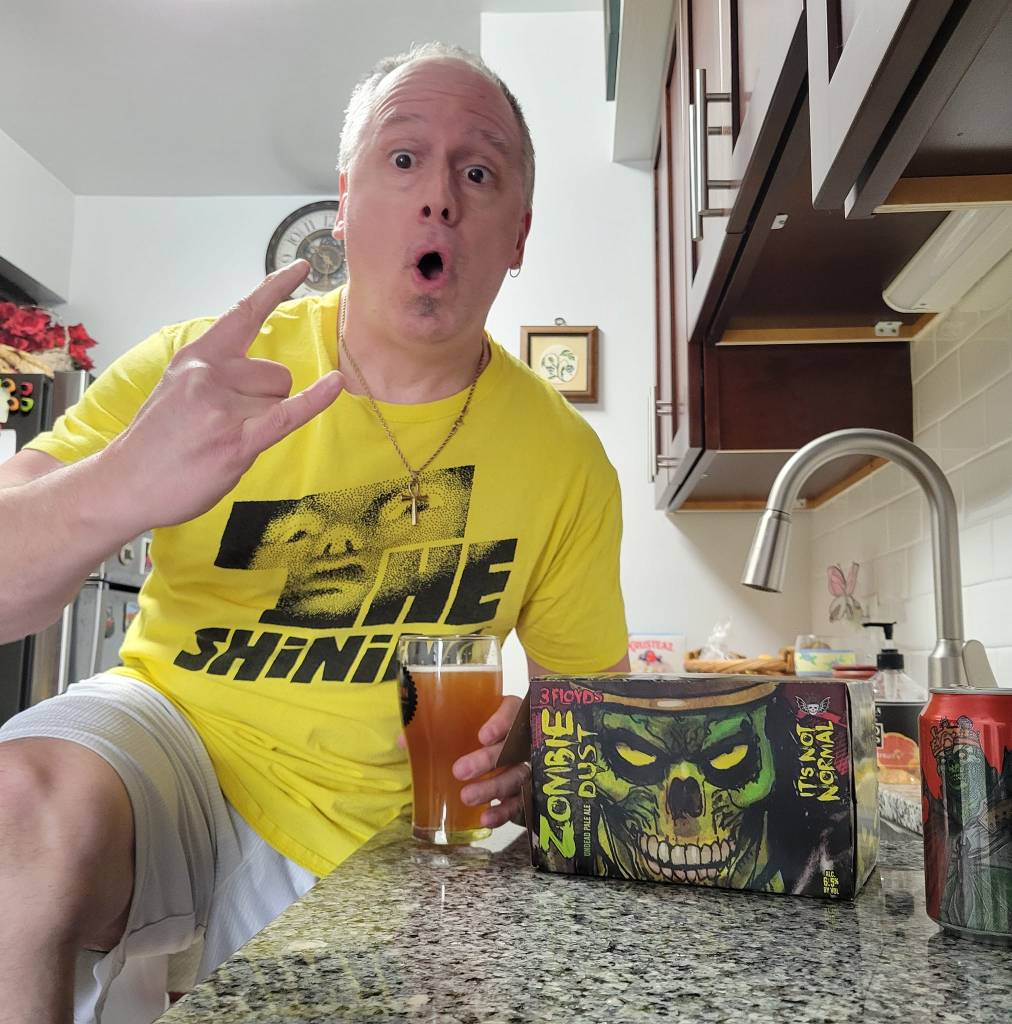
I have taken many paths in my writing career including horror film coverage for magazines and sites and I had a total blast with my first assignment for Rue Morgue mag last week. Yet finally getting the first book of my horror fiction out there is the most gratifying moment of my writing career so far. I celebrated with a befitting toast of Zombie Dust IPA, its ghoulish packaging art provided by comic book legend, Tim Seeley. It just felt right.

I will once again be published by Raw Earth Ink. I will keep y’all informed as Behind the Shadows comes to haunt the masses…

Thursday Throwback Jam – AC/DC – “Whole Lotta Rosie,” Live, BBC Sight and Sound in Concert 1977

At one time, my favorite song ever. Still one of the mightiest, bombastic boogie rock cuts anyone ever laid down. The riffs, man, the riffs. Did anyone at the time think the blues could shake and roar this much? Angus Young and company sure as hell did.

I’m still mystified how precise Angus strikes and solos with all of that relentless headbanging and Chuck Berry footwork that’s been his trademark all these decades AC/DC’s been a thing.

Here’s a loud and proud version of “Whole Lotta Rosie” circa 1977, live on the British Broadcasting Corporation. The snaggletooth Aussies planting their beefy cut about getting it on with a loose and thick lady with a greasy groove and featuring the late Bon Scott, one of my top vocalists ever, all respect due to the legendary Brian Johnson.

Crank it. That’s an order.

–Ray Van Horn, Jr.

My Short Story, “One Rainy Day in ’77” is Live at Flash in a Flash

Now live at Flash in a Flash, my short story, “One Rainy Day in ’77.”

You can also read my wife, TJ Perkins’ story, “The Stuff Scares Are Made Of” there.

Flash in a Flash Link:

Retro Ad of the Week – Beefing Up Your Meat Tooth

Poring through a handful of Marvel comics from 1978 this week (Avengers, Black Panther, Daredevil, Thor, Spider-Woman, Godzilla, Captain America and Peter Parker: The Spectacular Spider-Man, to be precise), I repeatedly ran across these whimsical Slim Jim ads from yesteryear. They used to make me smirk as a kid, even if I didn’t know what a Slim Jim was then, other than a metallic apparatus adults used to unlock their car doors when leaving their keys inside. In 1978, the stick meat products were found advertised heavily in comics with its “meat tooth” campaign, featuring classic Universal Monsters such as Dracula and The Wolf Man.

Mad magazine artist Paul Coker certainly enjoyed a good bit of freelance commissions with his gleeful caricatures including Slim Jim in the 1970s and their long running “Beef Up” campaign. Considering all the sports connections Slim Jim meat snacks would ally themselves with in the late 1990s and mid 2000s, it’s a wonder this particular slogan never resurrected.

Now when you think of Slim Jim snack ads, the de-facto pitchman coming instantly to mind is late wrestling megastar Randy “Macho Man” Savage and his “Snap into a Slim Jim!” cheer. So popular was this tactic other pro wrestlers like The Ultimate Warrior, Kevin Nash, Edge and Bam Bam Bigelow, plus other celebrities (who can forget the hollering antics of comedian Sam Kinison’s spot?) who lent their talents to the brand’s whip-crack huckstering. Worked like a charm, since Slim Jim probably sold better in the 1990s than any other decade.

Unless you’re a vegetarian, who hasn’t sat down with one of these pencil-thin snacks likened to a rolled-up pepperoni and salami sausage hybrid? Actual ingredients being inclusive of beef, chicken, soy and lactic acid. The oily texture of the sticks themselves is part of the experience but if you have a box of these things handy, I dare you, like Pringles or Girl Scout thin mint cookies, to eat just one.

My stepfather used to pound a whole box of Slim Jims with a couple of beers on a day off with westerns playing on the tube, his idea of heaven. Perhaps Paul Coker had managed to drop him subliminal messaging from the “Beef Up” series. Still, you have to tip your hat to Slim Jim’s moxy back in the 1970s for shoving their brand unsparingly at kids, parents, outdoor sportsmen, athletes and beer drinkers alike. They claimed their product to be “a little less than meal, a little more than a snack.”

The truth was in the Slim Jim.

–Ray Van Horn, Jr.

A Franchise Mash-Up We Totally Need!

Whoever came up with this is a genius.

Too bad 20th Century Fox no longer has the direct franchise rights to both Alien and Star Wars, which begun under their flagship in the 1970s, or something like this could well be within reach of scope. Fox was, of course, gobbled by Disney and rebranded as 20th Century Studios.

Make it happen, Disney!

–Photo courtesy of the public domain

Retro Ad of the Week – The REAL Christine – The 1958 Plymouth Fury

No doubt if you’re a horror fan, you’ve seen John Carpenter’s snap case adaptation for Stephen King’s 1983 classic novel, Christine. I have my beat-up paperback edition which my mom got for me in advance of taking me to see the film on Black Friday more than 40 years ago. I still smirk at King’s dedication of Christine, his love letter to 1950s street machines and the tunes which spun through those static-filled radio consoles, to horror director icon George Romero and his late wife, actress and film Christine Forrester Romero. And the Burg. Pittsburgh, where most of Romero’s films are set. Yinzers unite!

I’m grinning right now riffling through the paperback my mom bestowed upon me with Carpenter’s synth-hammering Christine score pounding like a creepy metronome while I write this. The DVD edition of this film sits on deck, and I’m grinning a second time thinking of the time I yanked it out of the player with my son (age 7 at the time, I believe) in the room watching. Both the novel and the film set precedents for profanity at the time of their releases, including the most innovative (if vulgar to an extreme for some women) with a lewd play upon the name of our chief protagonist-turned-antagonist, Arnie Cunningham.

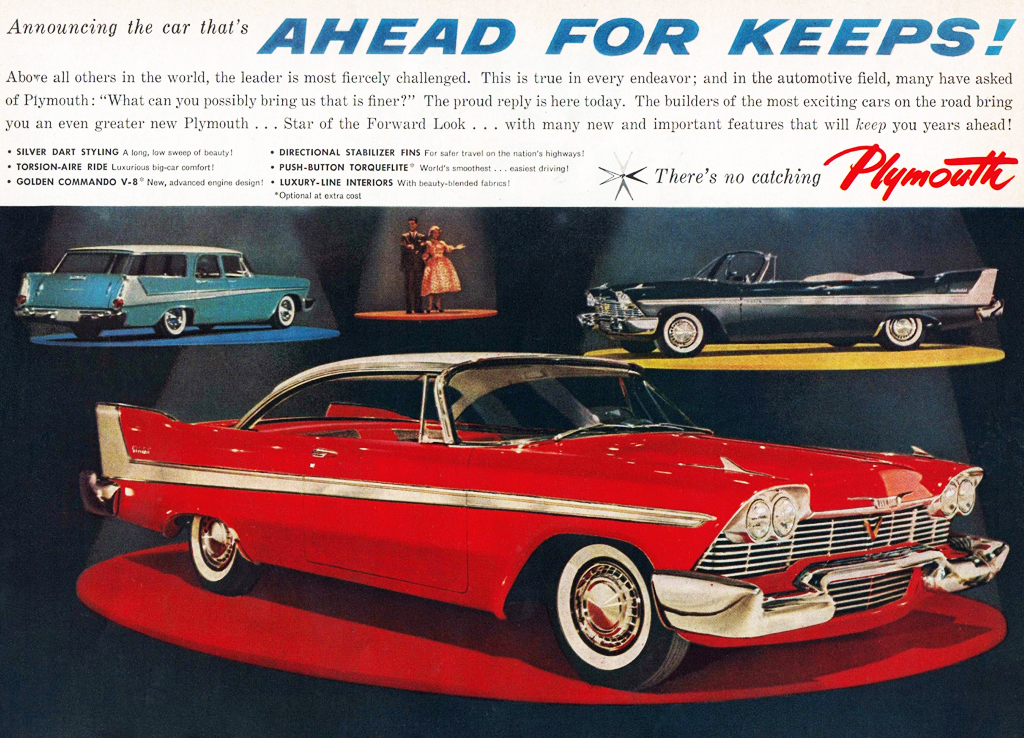
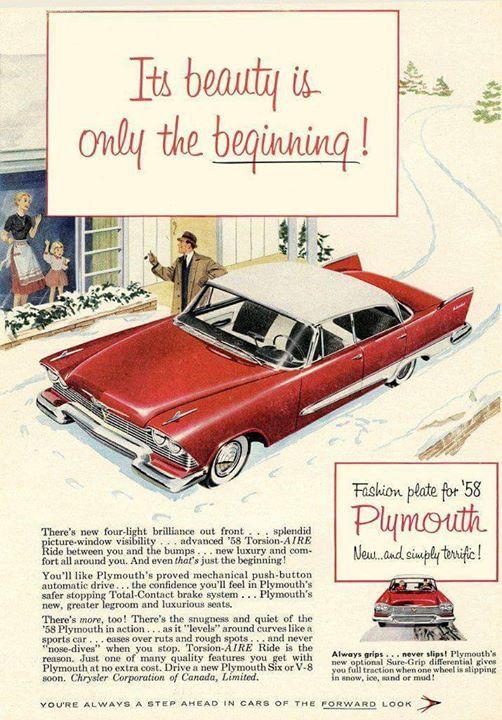
Christine is a story about obsession exploited from alienation via a supernatural blast from the past, a demonized, eight-cylinder, 290 horsepower ride out of Hell itself, a cherry red 1958 Plymouth Fury.

Plymouth no longer a thing in the automotive industry, they were a force to be reckoned with in the 1950s and Sixties, the Fury being a sub-series bred from the Plymouth Belvedere, produced from 1955 through 1989. The bumper wing guards and vertical tail fins mark the Fury and its competitors from an era where vehicle manufacturers still valued class and elegance. Except, maybe the Edsel, which my parents still groan at today with derision.

The two-door Fury with its white top roofing came with a (then-new) torsion bar front suspension system and twin four-barrel carburetors. There was the optional “Golden Commando,” lifting the thrust to 305 horsepower, dubbed a V-800 Dual Fury.

It’s that bracketry of the front grille and aluminum trim on the Plymouth Fury which perhaps attracted King to use one for his novel, a more lowbrow, violent and teen-targeted extension of the phantom car premise posited in the “You Drive” episode from The Twilight Zone.

The latter being a driverless 1956 Ford Fairlane sedan, it’s easy to see why the Plymouth Fury comes off much more sinister. Especially in a red so vivid it implies death, sin and sex. A four-wheel girlfriend for nerd-turned-hustler Arnie Cunningham set in jealousy mode against his improbable winning over a real, fleshly lady love, Leigh Cabot. I always loved King’s dichotomy here, since so many guys refer to their prized cars in the female vernacular. Some freakazoids actually making out with the cars themselves. True story.

Even loonier when the “girl” is a galvanized engine of destruction which (or who, in Christine’s case) can rebound and rebuild itself from severe vandalism by story bully, the tasteless Buddy Repperton and his dunderhead thugs. Someone’s gonna pay, be it a rival for affection or ruthless street trash. Cue Carpenter’s pealing synth and pumping death march.

Hard to think of such gory mayhem back in 1958 with the Fury being peddled to middle class white America…

–Ray Van Horn, Jr.