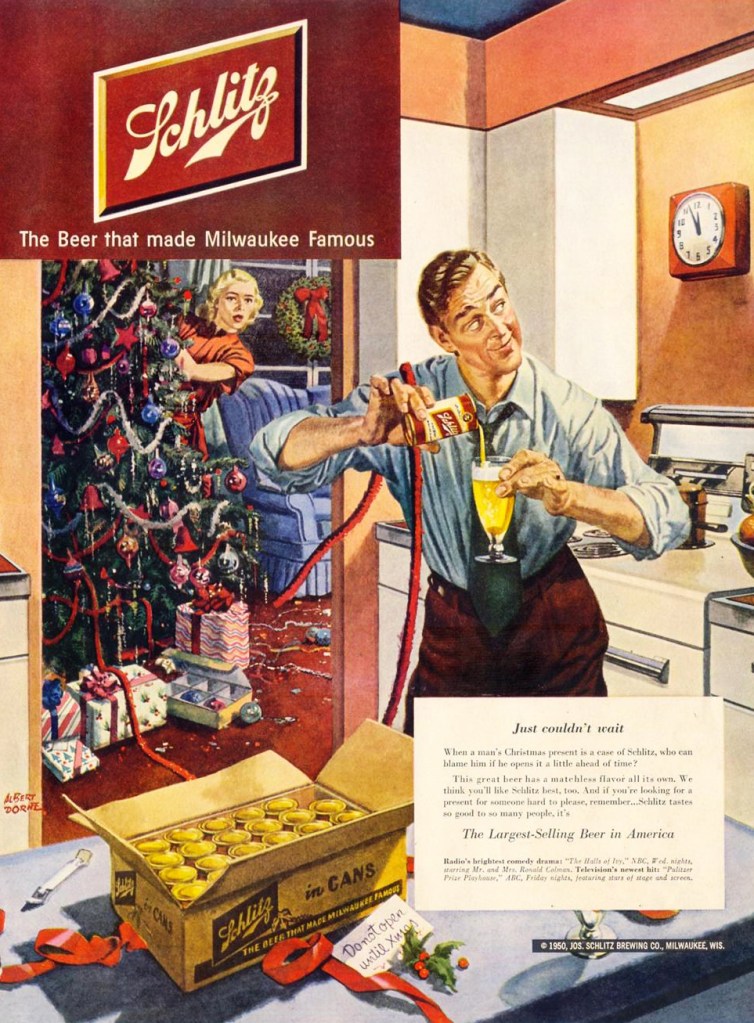
My dad was a rabid Schlitz drinker. With the age of microbrewing and higher APV (alcohol by volume) in today’s beers, it’s amusing to me Schlitz was considered a choice pilsner of its time. Honestly, Schlitz was the first beer I ever tasted from my dad, a sip once, then a full glass winning a bet I could take him in chess. I won’t tell you what ages those were. My dad was a ferocious chess player, and he beat his young, still-learning son over-and-over until he pissed me off by roasting me. I bet him and I won, fair and square. The man was flabbergasted, and he ponied up. My one and only time beating him at the game, since we never played again after that. Most satisfying victory of my life.
It took my stepfather much later in life (again, no ages divulged here) to refine my beer drinking tastes by introducing me to the German fineness that is Spaten Optimator. Dark, rich, it forever dictated my approach to beer appreciation. Now, in more recent years, I’m all over the place with beer. I hated IPAs originally, now I love them as much as stouts, bocks, ales, ambers, altbiers, Kölsch, Belgians and rich lagers.
So much I consider Schlitz one of the weakest beers ever produced. You want a rich, American classic lager? Laugh all you want, Pabst is king. You wouldn’t tell Schlitz was ever considered subpar in the American public, touting its totem, “The Beer that Made Milwaukee Famous.” Especially now, I think Milwaukee can do far better than that. Still, this holiday ad made me smile, made me think of my dad who loved this swill to both good and bad effects. It’s Christmastime, though, and I’d rather think of the good times with my late father. Steamed shrimp on Christmas Eve, just adult versions of father-and-son, Schlitz on the side. This ad’s for you, old man. I miss you.
Two more days… I remember when the original 1978 Halloween came out, I was living in Essex, MD and there was (and still is today, huzzah!) Bengie’s Drive-In Theater. We would pass the giant marquee advertising in bold letters: “HALLOWEEN.” Now, I don’t recall seeing the t.v. ads since I was only 8 eight years old, only that I figured it must have been a battle royale of classic monsters on Halloween night. Thus, I hocked the crap out my mom and stepdad to take me. True story!
They never caved, of course, and I laugh now at their faces I didn’t read for what they were until I became a parent myself and found myself in similar situations. I held the line with my kid to a certain timeframe, using my own path in horror exploration to what I felt was age appropriate. He dogs me all the time joking about it.
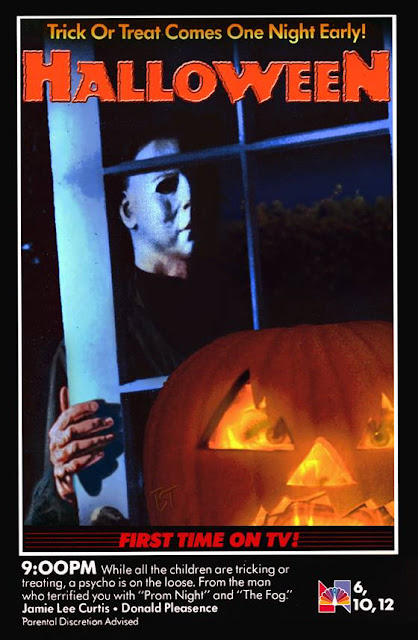
By the time I saw Carpenter’s original masterpiece, Halloween was coming on t.v. for the first time. Real deep fans of Michael Myers thus know there is a t.v. broadcast edit out there where some scenes were cut and 12 extra minutes were shot, including Jamie Lee Curtis wearing a towel over her head to hide her new crop. Best of all those t.v. only edits contained a deep probe into the sanitarium where little Michael was being held.
Let me tell you something, that scene creeped me out harder than the rest of the movie and I was on edge the entire way. To see a kid in my age bracket look utterly satanic like that! I happen to have a copy of the t.v. edit thanks to my dear friends, Jodi and Stan, two OG horror fiends like myself. By the time I saw the uncut version of Halloween, I was giddy at what I missed (P.J. Soles, looking at you, sister), but I also felt the sanitarium scenes could’ve been made part of an “Ultimate Cut” version.
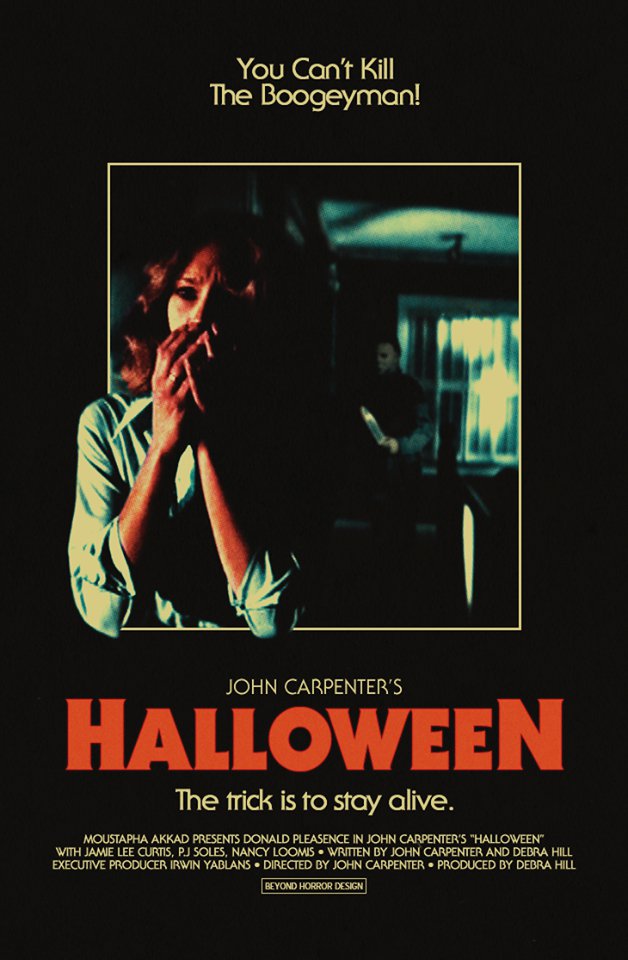
Still my absolute favorite horror film EVER, Halloween 1978 has its flaws, and I tend to get surrounded with cynics eager to point them out, lol, but it’s the raw, primal fear factor John Carpenter shoved at us. He transformed a Hollywood neighborhood into a fictitious Midwestern terror zone and there is still nothing scarier than the initial WTF moments Mikey is stalking Jamie Lee before Carpenter takes his finger off the trigger long enough to leave you ripe for a Myers-style picking. You can’t kill The Boogeyman!
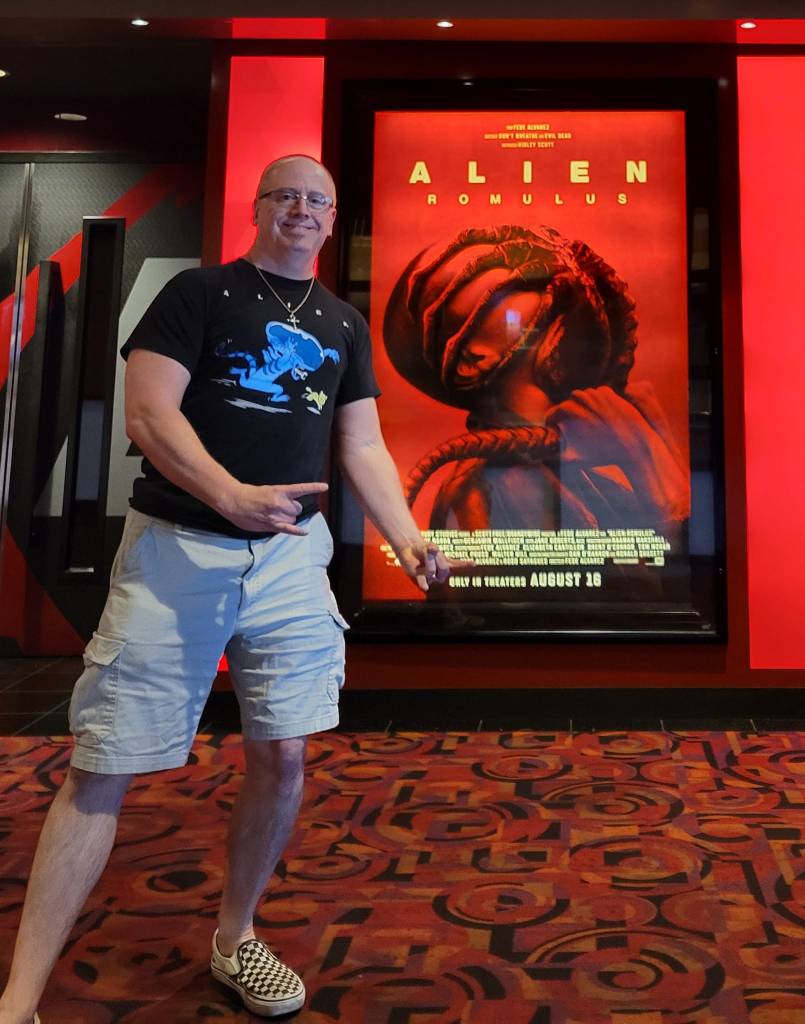
Have you seen the new Alien: Romulus? If not, you oughtta! We just got back from seeing the seventh film in the franchise (not including the two meh Alien vs. Predator films) and I can’t rave enough about the new movie bringing back the tension and horror elements of the 1979 original, homaging it and the 1986 sequel, Aliens. Director Fede Álvarez puts his own stamp on a franchise that lost its steam with noble intentions in Prometheus and Alien: Covenant, ignoring the awkward Alien: Resurrection and the snooze fest that was Alien 3.
Romulus is balls-to-the wall with a two-year connection to Ridley Scott’s game changing 1979 original, as a new crew of misfits stumble into the wreckage of the U.S.S. Nostramo from Alien and gets far more than they bargain for. It pleased me to see Scott acting as producer to this one and keeping it old school, I’m spinning the CD soundtrack of the late Jerry Goldmith’s magnificent score to the first Alien with James Horner’s clatter-filled backing to Aliens on deck. Benjamin Wallfisch (whose collab with legendary composer Hans Zimmer in Blade Runner 2049 is one of my therapy scores) took the musical duties for Romulus, and you can hear nods to Goldsmith in Romulus with screeching guitars heightening the climactic points. I shelled out extra for Cinemark’s XD theater, banking on the experience I was promised by reputable friends, and what a fragging show, in sight and sound.
Heralding the original Alien, I found this old newspaper ad using an outmoded phrase for movies up through the 1990s for movies outrunning their intended release course: “Held Over.”
As it implies, “Held Over” means the theaters across the nation booked extra running times with Hollywood studios for movies continuing to bring viewers in by word-of-mouth. Keeping in mind mainstream cinema back in the day had half the releases of today’s market. Anything with sales power today making it three weeks being considered a profit.
By 1970s and 80s standards, three weeks out there spelled a blockbuster to be “held over” an extra week or two to capitalize on the public interest, despite VCRs and cable t.v. beginning a future trend of at-home movie viewing. Don’t get me started on streaming; I have six subscriptions because that’s just the way of it. This despite my wife and kid being more than willing participants to actual movies. You just can’t beat it. The fact an indie horror film like Longlegs with a super-creepy performance by Nicolas Cage hung around theaters for five weeks (I caught it on the final day before it vanished) speaks loudly of its appeal in this streaming culture we’ve found ourselves in as a movie audience.
A terrifying visual spectacle like Alien was a monster kick in the nards of space epics, considering the first Star Wars in 1977 was one of the longest held over movies of all-time, returning for a second engagement a year later. 1979’s Alien is still a terrifying movie all these years later and thank the gods Fede Álvarez chose to drop his new entry into the tailspin of Ridley Scott’s original masterpiece. Romulus is thus validated by attrition. The fact it wastes no time trying to curry your favor to a Ripley-stripped cast and drop them into a familiar if fascinating new terror zone speaks of why Romulus may be held over an extra week or two in its own right.
In space, no one can hear you scream. Unless you’re Isabela Merced as Kay in Alien: Romulus. Even the rings of Saturn were shredded by her piercing shrill.
It’s a rare comeback down 3 games to none, but the Edmonton Oilers have done just that against the Florida Panthers in this year’s Stanley Cup tournament and tonight someone’s taking home the hardest to win trophy in sports!
Game 7s, no matter what stage in the Stanley Cup playoffs, are almost always gems, the most intense, go-for-broke yet highly cautious matches. I used to cover NHL games for a year in 1999 and Game 7s were always the most palatable, the most buzzworthy. When a Game 7 is played for all the marbles like tonight, it’ll either be balls-out mayhem or a chess match on ice.
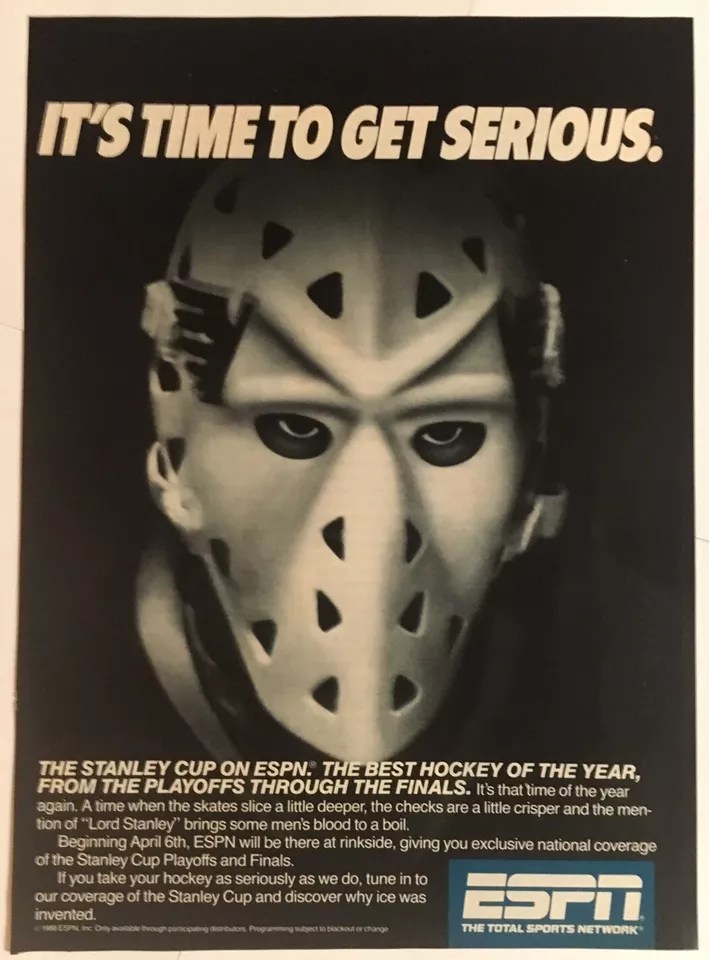
This ad from the 1988 Stanley Cup Finals says it all, which is not to give a predetermined outcome for the 2024 edition, even if Edmonton won it all behind the immortal Wayne Gretzky in 1988. Will current Oilers captain Connor McDavid replicate the same magic, or will Alexander Barkov lead Florida to a home ice lifting of Lord Stanley’s hardware?
We’ll know by the end of the night, but don’t be surprised if it takes double or even triple overtime to settle this thing. Like this old ESPN ad says, it’s time to get serious.
Poring through a handful of Marvel comics from 1978 this week (Avengers, Black Panther, Daredevil, Thor, Spider-Woman, Godzilla, Captain America and Peter Parker: The Spectacular Spider-Man, to be precise), I repeatedly ran across these whimsical Slim Jim ads from yesteryear. They used to make me smirk as a kid, even if I didn’t know what a Slim Jim was then, other than a metallic apparatus adults used to unlock their car doors when leaving their keys inside. In 1978, the stick meat products were found advertised heavily in comics with its “meat tooth” campaign, featuring classic Universal Monsters such as Dracula and The Wolf Man.
Mad magazine artist Paul Coker certainly enjoyed a good bit of freelance commissions with his gleeful caricatures including Slim Jim in the 1970s and their long running “Beef Up” campaign. Considering all the sports connections Slim Jim meat snacks would ally themselves with in the late 1990s and mid 2000s, it’s a wonder this particular slogan never resurrected.
Now when you think of Slim Jim snack ads, the de-facto pitchman coming instantly to mind is late wrestling megastar Randy “Macho Man” Savage and his “Snap into a Slim Jim!” cheer. So popular was this tactic other pro wrestlers like The Ultimate Warrior, Kevin Nash, Edge and Bam Bam Bigelow, plus other celebrities (who can forget the hollering antics of comedian Sam Kinison’s spot?) who lent their talents to the brand’s whip-crack huckstering. Worked like a charm, since Slim Jim probably sold better in the 1990s than any other decade.
Unless you’re a vegetarian, who hasn’t sat down with one of these pencil-thin snacks likened to a rolled-up pepperoni and salami sausage hybrid? Actual ingredients being inclusive of beef, chicken, soy and lactic acid. The oily texture of the sticks themselves is part of the experience but if you have a box of these things handy, I dare you, like Pringles or Girl Scout thin mint cookies, to eat just one.
My stepfather used to pound a whole box of Slim Jims with a couple of beers on a day off with westerns playing on the tube, his idea of heaven. Perhaps Paul Coker had managed to drop him subliminal messaging from the “Beef Up” series. Still, you have to tip your hat to Slim Jim’s moxy back in the 1970s for shoving their brand unsparingly at kids, parents, outdoor sportsmen, athletes and beer drinkers alike. They claimed their product to be “a little less than meal, a little more than a snack.”
No doubt if you’re a horror fan, you’ve seen John Carpenter’s snap case adaptation for Stephen King’s 1983 classic novel, Christine. I have my beat-up paperback edition which my mom got for me in advance of taking me to see the film on Black Friday more than 40 years ago. I still smirk at King’s dedication of Christine, his love letter to 1950s street machines and the tunes which spun through those static-filled radio consoles, to horror director icon George Romero and his late wife, actress and film Christine Forrester Romero. And the Burg. Pittsburgh, where most of Romero’s films are set. Yinzers unite!
I’m grinning right now riffling through the paperback my mom bestowed upon me with Carpenter’s synth-hammering Christine score pounding like a creepy metronome while I write this. The DVD edition of this film sits on deck, and I’m grinning a second time thinking of the time I yanked it out of the player with my son (age 7 at the time, I believe) in the room watching. Both the novel and the film set precedents for profanity at the time of their releases, including the most innovative (if vulgar to an extreme for some women) with a lewd play upon the name of our chief protagonist-turned-antagonist, Arnie Cunningham.
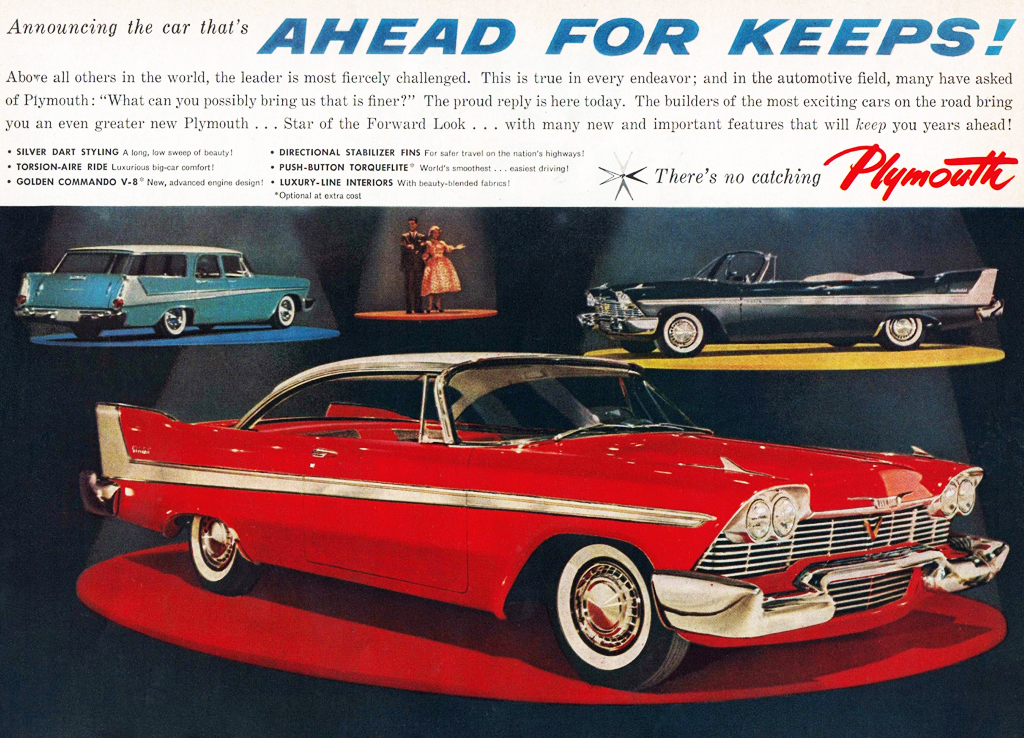
Christine is a story about obsession exploited from alienation via a supernatural blast from the past, a demonized, eight-cylinder, 290 horsepower ride out of Hell itself, a cherry red 1958 Plymouth Fury.
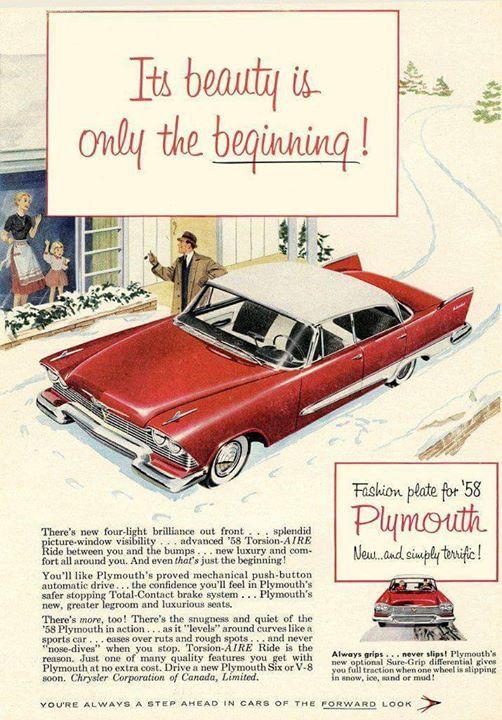
Plymouth no longer a thing in the automotive industry, they were a force to be reckoned with in the 1950s and Sixties, the Fury being a sub-series bred from the Plymouth Belvedere, produced from 1955 through 1989. The bumper wing guards and vertical tail fins mark the Fury and its competitors from an era where vehicle manufacturers still valued class and elegance. Except, maybe the Edsel, which my parents still groan at today with derision.
The two-door Fury with its white top roofing came with a (then-new) torsion bar front suspension system and twin four-barrel carburetors. There was the optional “Golden Commando,” lifting the thrust to 305 horsepower, dubbed a V-800 Dual Fury.
It’s that bracketry of the front grille and aluminum trim on the Plymouth Fury which perhaps attracted King to use one for his novel, a more lowbrow, violent and teen-targeted extension of the phantom car premise posited in the “You Drive” episode from The Twilight Zone.
The latter being a driverless 1956 Ford Fairlane sedan, it’s easy to see why the Plymouth Fury comes off much more sinister. Especially in a red so vivid it implies death, sin and sex. A four-wheel girlfriend for nerd-turned-hustler Arnie Cunningham set in jealousy mode against his improbable winning over a real, fleshly lady love, Leigh Cabot. I always loved King’s dichotomy here, since so many guys refer to their prized cars in the female vernacular. Some freakazoids actually making out with the cars themselves. True story.
Even loonier when the “girl” is a galvanized engine of destruction which (or who, in Christine’s case) can rebound and rebuild itself from severe vandalism by story bully, the tasteless Buddy Repperton and his dunderhead thugs. Someone’s gonna pay, be it a rival for affection or ruthless street trash. Cue Carpenter’s pealing synth and pumping death march.
Hard to think of such gory mayhem back in 1958 with the Fury being peddled to middle class white America…
No coincidence I should find, while reading a handful of retro Godzilla comic books from 1977, released back then by Marvel, this ad. For what appears on the face, to be another beastie (this time from the depths) socking humanity upside its arrogant choppers.
First takeaway, those Godzilla comics fetch a hefty bit of coin these days and for fun, I’ve been checking out a few local comic shops to see what, if any, have available for sale on the brick-and-mortar circuit. With the runaway successes of Godzilla: Minus One and Godzilla x Kong: The New Empire, it should be no surprise I found but one Marvel Godzilla comic out there, one I didn’t already own and keeping a tuckaway gift card for such occasions, it came home with me. You want these bad boys, the IDW imprint Godzilla books (or anything Godzilla-related), you’ll be doing much of your hunting online and be prepared to pay. The look on two of those comic shop owners was priceless as I faked being some clueless newbie asking around for Godzilla merch. I wanted to see what I already knew. Other than t-shirts, the big G is really tough to find in the open-air market. Godzilla is hot right now, point-endpoint.
Next, we come to this movie, Orca, also from 1977 and I remember as a kid reading comic books how goddamn impressive, how goddamn scary this movie looked by the movie art alone. This ad came up so often in my comic stash it’s a wonder I didn’t beg the snot out of my parents to take me to see it. The only explanation being Star Wars: A New Hope had come out the same year and nothing ruled my life harder. Kiss, The Electric Company and baseball behind that.
Now, if you’re sitting there thinking this revenge tale of a killer whale having the cognitive wherewithal to go serial killer mode (or at least oceanic Bruce Lee style) upon a Nova Scotia waterfront town is batshit crazy, you’d be correct. Moreover, targeting a ruthless Irish Canadian sea captain and his crew who killed his mate is not only a Jaws and Moby Dick wannabe, then ding-ding goes the dinghy of familiarity.
The movie poster made Orca look more epic than it was, similar to the 1977 King Kong remake poster that was ten times more formidable than the final product. Paramount Studios had a big year in ’77 and the movie posters to prove it.
Orca is a bit of a mess but worth at least one watch if you don’t expect it to live up to its pitch. There was no technology other than cable wires difficult to hide (there was no computer airbrushing at the time) to recreate the visceral sight of a harpooner taking his likely final mortal shot in midair. Instead, this film submerges us into the appalling premise of a captain so hellbent on retiring with a healthy payout he turns on another orca saving his crewman from the great white shark he’s been pursuing for a local aquarium.
Skewering the pregnant female mate of our titular killer whale turned apex predator, then dumping the miscarried fetus overboard is about all you can stand from this movie produced by the legendary Dino De Laurentis and featuring a hefty cast including Richard Harris, Robert Carradine, Charlotte Rampling, Will Sampson and even Bo Derek. Effective enough in creating sympathy for an aggrieved whale and less for Harris’ Captain Nolan, considering he too has lost his wife and child, but it’s up to you if you want to hang around to see this thing play out its icy finish at the Strait of Belle Isle. Reportedly Richard Harris insisted on doing his own stunts in the polar-bound finale and nearly died a few times.
That harrowing bit aside, Orca is a classic case of marketing prowess with its product coming up well beneath the hype.
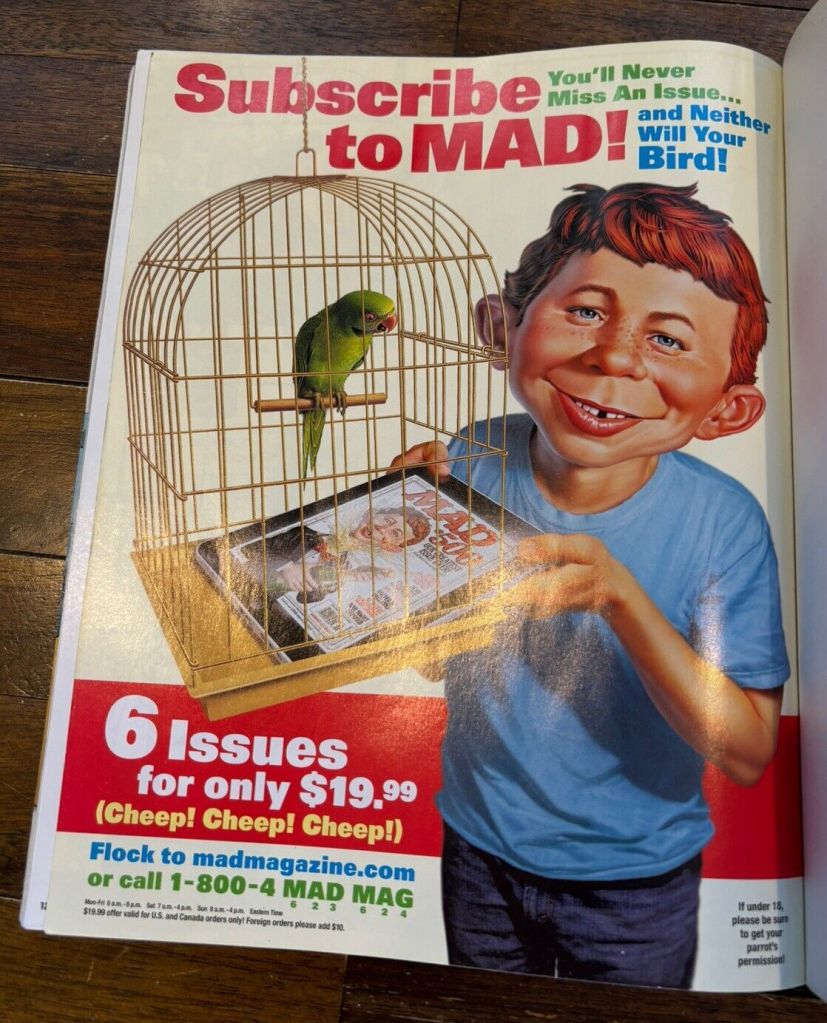
While I’m in an EC Comics frame of mind this weekend, let’s talk about everyone’s favorite illustrated satire magazine, Mad.
Originally released in 1952 under the EC banner by Harvey Kurtzman and William Gaines, the original incarnation of Mad was written almost entirely by Kurtzman and it had a far different look and attack plan than what most people know it for, if still slinging its trusty brand of shenanigans straight from the gate.
After 24 issues at EC, Mad shifted its tone, artistic vision and blazing lampoonery toward roasts of pop culture, movies, t.v. shows, politics, sports, consumerism, sexuality and society at large. Moreover, the new order of Mad birthed a flagship mascot who has endured and schlocked each cover for seven decades, the gap-toothed lieutenant of lampoon, Alfred E. Neumann. “What, me worry?” being Alfred E.’s call-to-arms for all knuckleheads at-heart.
Iconic creators who any Mad habitue can roll off their tongues like Al Jaffee, Sergio Aragones, Dave Berg, Don Martin, Mort Drucker, Frank Jacobs and Antonio Prohias came along in the mid 1950s with the shift in editorial leadership from Kurtzman to Al Feldstein. The 1960s through the 1980s was the most prolific time period for Mad, and no glittering personality was safe. Some had the sense of humor to embrace being tomahawked by Mad’s “usual gang of idiots.”
Heralded as Mad magazine’s proto pantheon (along with artist Will Elder from the roots of the magazine), no creative team since has been able to match these juvenile delinquents of parody. Well, maybe Tom Bunk has a case. So glaring is the fact that Mad continues to reprint its classic pages from these artists and writers, not merely in the countless double-sized “special” compilations, but also since pulling the wool over their readership’s eyes by announcing the magazine’s finality in April of 2018. Only to hoist the same marketing trick as comic book imprints themselves, rebooting and resetting at a new volume Issue # 1 that same year. Dirty pool, but that’s the name of the game in the funny book business these days.
I’ve had in-and-out love affairs with Mad magazine, about which William Gaines himself is once quoted as saying “We must never stop reminding the reader what little value they get for their money!” while issuing the caveat to his audience of thinking for themselves. When I’ve gotten on Mad benders at different times in life, I’ve sat there chuckling the hardest at Spy vs. Spy segments (even under threat of tickle torture, I’ll never tell which one I’ve rooted for all my life), Don Martin’s one-pager cartoons of buffoonery, Dave Berg’s always insightful “The Light of Side of…” and anything Al Jaffee wrote or drew.
Especially his essential “Mad Fold-Ins” that I learned to develop a soft touch with so as not to violate the minting of the book. Sorry, that just comes from having worked in comics retail during the early 1990s. Even when there were gloriously sinful boobies molded from those maniacally brilliant fold-ins. Jaffee, more than anyone pushing the envelope with snot, barf and pimply bare butt gags in Mad, went there whenever he could get away with it.
I’ve twice had subscriptions (definitely the best way Mad can validate its claim of “Cheap!”) and I’ve enjoyed passing them back and forth with my stepfather, who, like me, has read the magazine in sporadic chunks of years, but also like me, ravenously while dug in. As a teenager in the 1950s, he was there in the beginning of Mad and let me tell you something; I never saw such joy in a man’s face when I brought him a copy of Mad’s 2024 Free Comic Book Day torching of DC Comics superheroes. Same as my birth father, who’s deadly accurate hand-drawn recreations of Don Martin’s bubblehead dolts were amongst his proudest achievements outside of model railroading. One of his clients for a commission piece being none other than Rod Stewart.
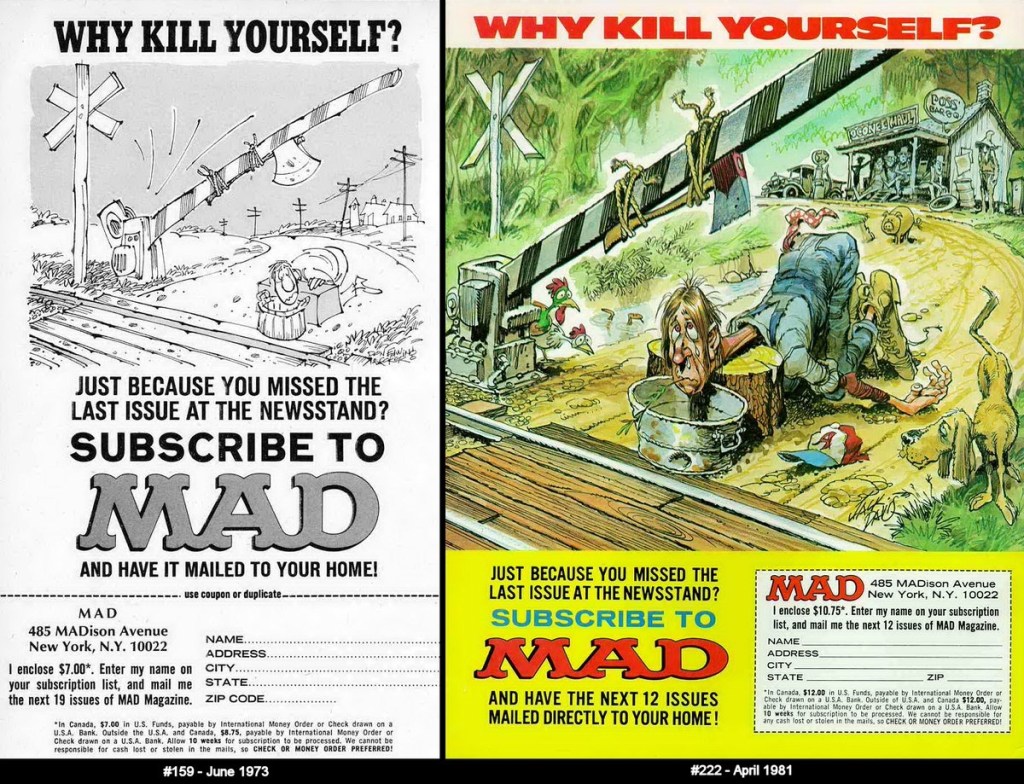
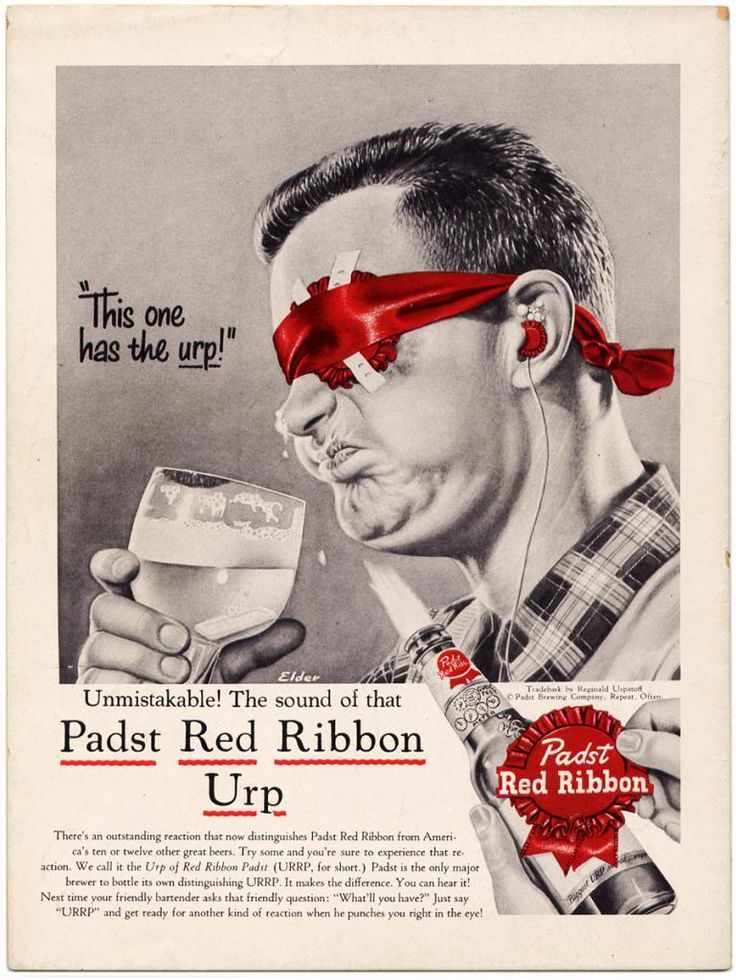
These ads plugging the magazine itself are a riot, but anyone who’s a longtime Mad buff will attest the magazine was lauded for its specialty in goofing on existing products with the same expert adolescent trash humor as Wacky Packages stickers, which used to rule my life from ages 9 to 12. Sometimes Mad got downright uncomfortable decades before the age of cancel and political incorrectness. An example being the model’s penchant for young boys in Mad’s “Clairold” hair product spoof, which was hilarious once, nowadays a one-way ticket to the sex offender registry.
This classic dish on Pabst Blue Ribbon beer (no coincidence, my stepfather’s go-to brew) is probably my favorite Mad ad pasquinade ever. Urrrrrrrrp!!!
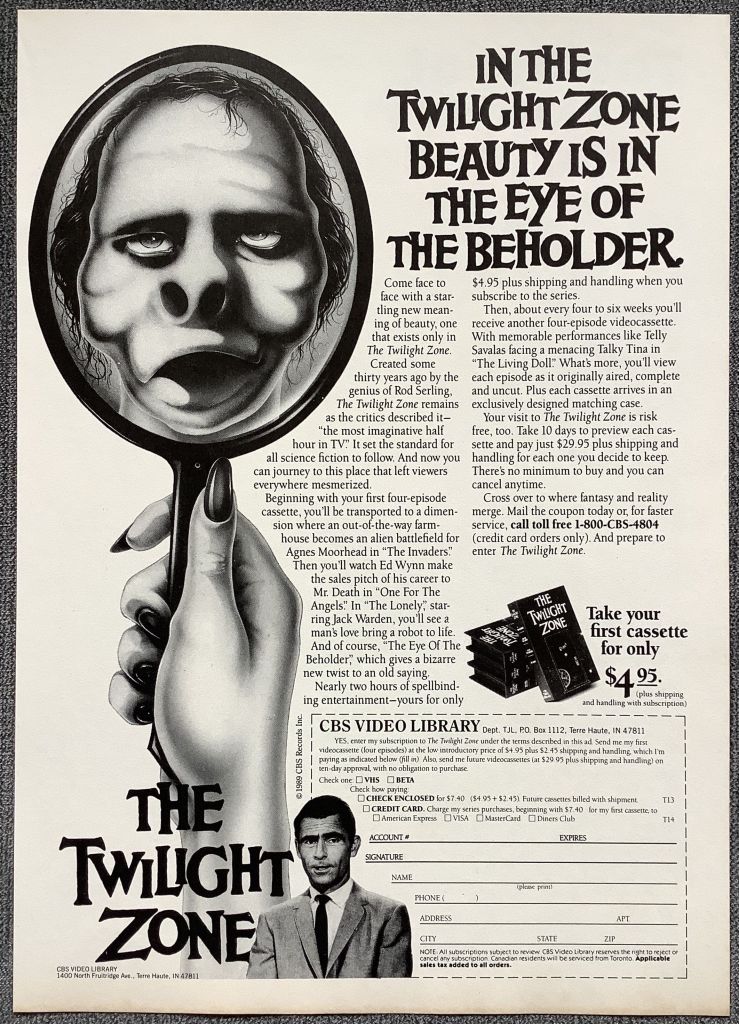
TJ and I have been binging episodes of the original incarnation of The Twilight Zone which ran in glorious black and white from 1959 to 1964. Not on SyFy or MeTV, or streaming, but through five DVD box set “Collections” of the series.
At one time running $120.00 a pop when there was such a thing as Suncoast Video (remember those chain home video emporiums?), then down to $99.99 (marketing is everything, including shaving a single penny from a retail price). Nowadays, people stream or check in for multiple hours on three-day Twilight Zone extended weekend marathons, but TJ and I are content to roll through one disk of 3-4 commercial-free episodes in one sitting. On our time. Usually with ice cream or a cup of tea.
Now I wasn’t even a thought when the series first aired, but during the 1980s, an independent UHF station my family was able to get out of Harrisburg, Pennsylvania from Hampstead, Maryland used to run Twilight Zone every weeknight at 10:30 p.m. Whatever I was doing during my teens, whether it was hanging in the living room with my folks for t.v., gabbing with friends on a land line phone, spinning heavy metal and punk rock albums in my bedroom, reading comic books and Stephen King novels or rolling horror movies on my VHS player, I always landed each time for Twilight Zone.
I looked forward to it as much to listening to my mom and stepfather tell me stories from their youth while watching the show and especially watching their anticipation glancing at me to see my own reaction to these gems on my first pass-through of each mind-altering nugget from The Fifth Dimension. No, not the soul group (whom I do love), but Rod Serling’s fantastical phantasmagoria and alternate world escapades.
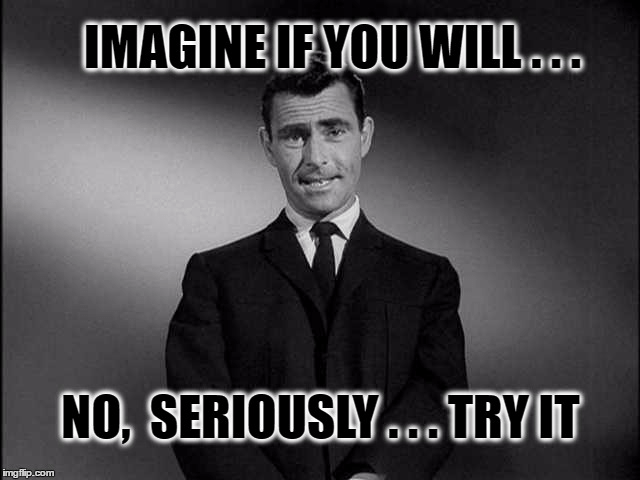
This is my absolute favorite television show of all-time and I can watch these shows on repeat without ever growing bored, even with the show’s repeated use of certain backlot studio sets (also used in the original Star Trek and Batman ’66, amongst others). In fact, I always find something different from repeat viewings, usually some clever bit of snark from host Rod Serling, who may not have had an upper lip and who couldn’t make his narrative appearance without a lit cigarette, but whose voice remains an imprinted icon. When something’s just a little weird in life you can’t explain, it’s Rod’s low-pitched monotone laced with snappy sarcasm you hear, isn’t it? Followed by the trademark do-da-do-dooo show theme.
Serling, Charles Beaumont and Richard Matheson wrote the majority of the Twilight Zone’s original half hour format shows (with commercial breaks) before expanding to a full hour in the final season due to public demand. These authors of the strange, along with Stephen King, Ray Bradbury and EC horror comics, are my immediate pantheon in writing who taught me and continue to teach with every spin through their seminal works.
My favorite Twilight Zone episode ever is “The Eye of the Beholder.” For me, the greatest “gotcha!” ending ever penned. Right on its heels being the final gasp and weep from Burgess Meredith as sole survivor of a nuclear holocaust in “Time Enough at Last.” Watch either and become a believer.
It’s hard for me to rank my favorite episodes beyond those two because nearly every show was genius level until the hour format. I would rank as upper echelon “Stopover in a Quiet Town,” “Living Doll,” “Black Leather Jackets,” “The Invaders,” “It’s a Good Life,” “From Agnes With Love,” “A Game of Pool,” “A Kind of Stopwatch,” “Caesar and Me,” “King Nine Will Not Return,” “The Hitch-Hiker,” “Dead Man’s Shoes,” “A Stop at Willougby,” “Steel,” “Where is Everybody?” “The Monsters Are Due on Maple Street,” “You Drive,” “Number 12 Looks Just Like You,” “Mr. Dingle, the Strong,” “Will the Real Martian Stand Up?” and everyone’s favorite demon-on-a-plane-or-is-it? dramarama featuring William Shatner, “Nightmare at 20,000 Feet.” Especially precious is The Honeymooners’ Art Carney as a drunken Santa Claus getting his one night of gift-giving comeuppance in “Night of the Meek.”
The Twilight Zone came back in three other reboots, not including Rod Serling’s Lost Classics from 1994. Following the success of 1983’s Twilight Zone: The Movie (great stuff, but really just a then-contemporary spit shine upon four of the original classics), there was a redux running from 1985 to 1989 which had its moments. None of it compares to the original, the reason we wanna hang inside for a little while and maybe stay up half the night all Memorial and Labor Day weekends. After I hit publish to this post, TJ and I have “Long Distance Call” from Season 2 cued up in the player.
First off, sorry for the slack in production here at Roads Lesser Traveled! I was hyper focused on finishing my next major project manuscript and will talk about that shortly.
I have no idea how I veered to Trojan condoms while perusing a gallery of vintage advertisements for an entirely different product. Maybe because I was humming a heavy metal tune in my head while doing so, weirdly bleeding into the call-and-response vocals and humming for the Trojan Man slogan. Sing along with me, if you’re inclined, deep baritone if you can pull it off: “Tro-jan Maaaaaan! Tro-jan Maaaaan! Mmmmm-hmmmm-hmmmm…mmmmm-hmmmm-hmmmm…”
M’kay, so with that in mind, I’ll strive to keep this delicate theme as clean as possible. You know what Trojan hucksters. As a teenaged boy, you no doubt circled the contraceptive section of your local pharmacy or Wal Mart like a vulture over carnage, trying to figure out how to get your hands on a box of latex rubbers without the whole dang store (adults, especially) being all up in your business. Hate to say, my dudes, it’s a rite of passage thing. Inescapable unless your vocation has led you toward a seminary.
If you have a girlfriend willing to play, buying condoms gives you more incentive. Bragging rights if you’re confident enough. If you buy Trojans (Magnums if you’re a true playa) or their competitors, Skyn, LifeStyles, Durex or Kimono merely with the hope of being prepared in the event of, then you know full well it’s an awkward buying experience. Something you buy extra things to smother it with at the checkout line like a pack of toilet paper, a half pint of milk and some Hostess Ding Dongs. Okay, I’m being naughty, I’ll stop.
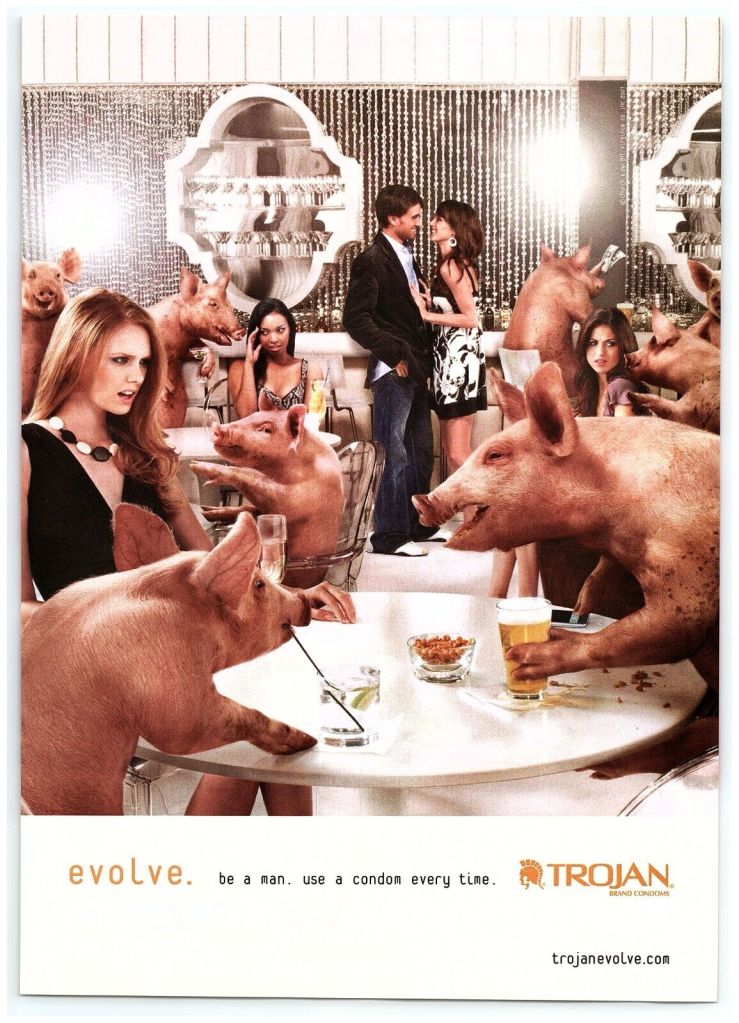
The entire purchasing experience probably as awkward as this hysterical ad for Trojan with its blunt message, Only a pig doesn’t protect himself and his partner when the big moment comes.See what I did there? I said I’d stop, sorry, my bad. Nyuk nyuk, woo woo woo!!!
Evolve, my friends. Or something. Or skin it if you and your partner are just that certain. “Mmmmm-hmmmm-hmmmm…mmmmm-hmmmm-hmmmm…”










 Roads Lesser Traveled