As a longtime comic book hound, I’ve had my in-and-out dalliances with Superman. One of the all-time greats of the genre. At one point, the indisputable king of superheroes. Love him or hate him as a comics fan or you just enjoyed watching George Reeves in the 1950s play the Man of Steel on the tube or the immortal Christopher Reeve (THE Superman, for my tastes) in his four movies. You can’t erase the fact Kal-El and his symbolic “S” totem has united an entire world for 85 years now.
85. Let that number soak in a bit. Nearly nine decades since Action Comics # 1 changed pop culture and turned kids and grownups alike into closet heroes tying bedsheets around their necks in pretend of crime-busting glory. More refined and with higher fashion stakes, they call it cosplay these days.
I love Superman and always will, but DC Comics hasn’t maintained my interest in the character since their New 52 and Rebirth initiatives. For those not initiated or all that deep into comics, I’m talking about relaunches and rebrands of the house books with brand new # 1 issue resets designed to garnish hype and interest for new generations coming to comics. DC and Marvel Comics are both guilty as sin, however, of taking it one step further, halting ongoing series under a set creative writing and art team to begin all over again with a new team in place. It’s getting tiresome and difficult to maintain brand loyalty, especially with recent cover price hikes.
You can beat yourself senseless trying to make sense of this off-kilter numerical continuity once you look at a tiny imprint “legacy” issue number like Marvel does, keeping a faint count of the actual number of issues a title has run of its full course. All in design of smoke screening hooked readers toward oversized, price-spiked “anniversary” gala issues of the title’s real-time sequencing. I’ll pause for you to hit the ibuprofen.
Thus, this week’s Superman # 7 from DC is actually issue number 850 had the publisher stuck to an actual count of releasing without all of the back-to-one chronological reordering. Need I further stymie the situation by mentioning DC reloaded the Superman title back to # 1 in the 1980’s?
Getting to the point of my rant-in-disguise-of-celebration, I won’t lie that Superman # 7 (circa 2023 and the new label initiative “Dawn of DC”) really didn’t cut it for me. Not even Daily Planet editor Perry White opening the issue with some tender introspection before announcing his running for mayor of Metropolis. Not even with Lex Luthor’s seeming rehabilitation and enlightenment in retrospection of his time being thwarted by Clark Kent and Superman, all these designed to hoist the “anniversary” flag of the comic as happens in every 50 or 100 issue storylines. Hell, this trope of Lex turning good has happened before and conveniently played the same time Norman Osborn has been absolved of his Green Goblin sins over in the competitor’s Amazing Spider-Man.
I didn’t even care about the scraggly, chained bad guy, Sammy Stryker, carrying a vendetta against Lex Luthor and, of course, Metropolis itself. Nor the Dr. Frankenfurter in a wheelchair and his mop-headed, trench-wearing cohort, Dr. Pharm and Mr. Graft. I’m not trying to be a dick, because I love comics with all my heart and I’m a writer too, but even with an entire team of “Supers” joining Kal-El’s endless crusade for justice, it’s all just whatever.
With the bold exception of Lee Bermejo’s poignant and beautiful variant cover, the real reason I allowed myself to be suckered into buying this issue. This, my friends, boiling down to a kid pantomiming Superman in his bedroom while the real Super McCoy swoops by… This is why Superman still matters.
I say it every time I write about comic books; they’ve been a near lifelong passion since my parents bought me Marvel Team-Up # 72 in the early summer of 1978. Spiderman and Iron Man in a vicious tag-team takedown of Tony Stark’s brutal nemesis, Whiplash. It was for the three-hour schlep down to Ocean City, Maryland. Even at age 8, I could whisk through books reasonably fast, since I’ve always loved reading. This however, my first comic book, was an earth-shattering experience, a game-changer. I was hooked immediately. I read it three times on the drive to OC, twice more on the way home.
Flashing forward, I have thrice built a massive comic book collection which I’ve twice pared down in sale, the first due to necessity when we were piss poor and in dire need of immediate cash to pay our bills during layoffs. As painful as having to sell my drum kits, congas, even my Eddie Murray and Cal Ripkin, Jr. autographed baseball. You do what needs must when you gotta keep the creditors off your tail.
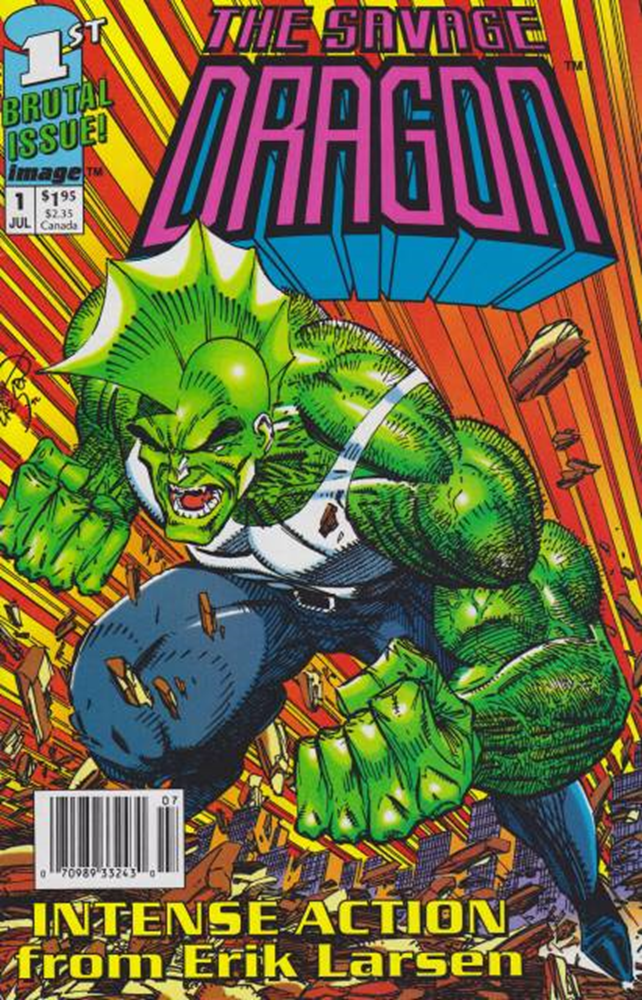
I’ve worked in comics retail, at the very dawn of indie publishing juggernaut, Image Comics. I can still see those Youngblood, Shadow Hawk, Spawn, Savage Dragon, Wild C.A.T.S., Bloodstrike and Cyber Force comics disappear within an hour of store opening. You had immortal indie classics like Cerebus, Bone, The Crow, Tank Girl, Judge Dredd and Maus back then, plus a more mature audiences-driven Teenage Mutant Ninja Turtles before they became Saturday morning kiddie pop couture. Image proved at a time when Marvel and DC were flinging a lot of dreck in the early 1990s there was a market to claim outside of the Big Two. Even if those early Image years had their share of thong-split spandex, clunky tech armor, basement curtain-sized capes and impossible hair poofs of the super-damned as much as Marvel and DC.
Thank the comics gods for Savage Dragon and Spawn, along with Stan Sakai’s samurai rabbit, Usagi Yojimbo. Sakai has long served as the model for independent artist-writer projects, like Teenage Mutant Ninja Turtles (with whom Usagi has mingled numerous times in comics, cartoons and action figure lines), starting in black and white comics before switching to color.
Sidebar, below is my copy of Usagi’s first issue run after his debut in the cult classic anthology, Albedo Anthropomorphics, signed by the man himself. Many people address him formally as “Mr. Sakai,” as I did when meeting this humble, generous soul. He doodled Miramato Usagi on this and another comic for me and he took a picture with me at the comic con, asking for not a single dollar.
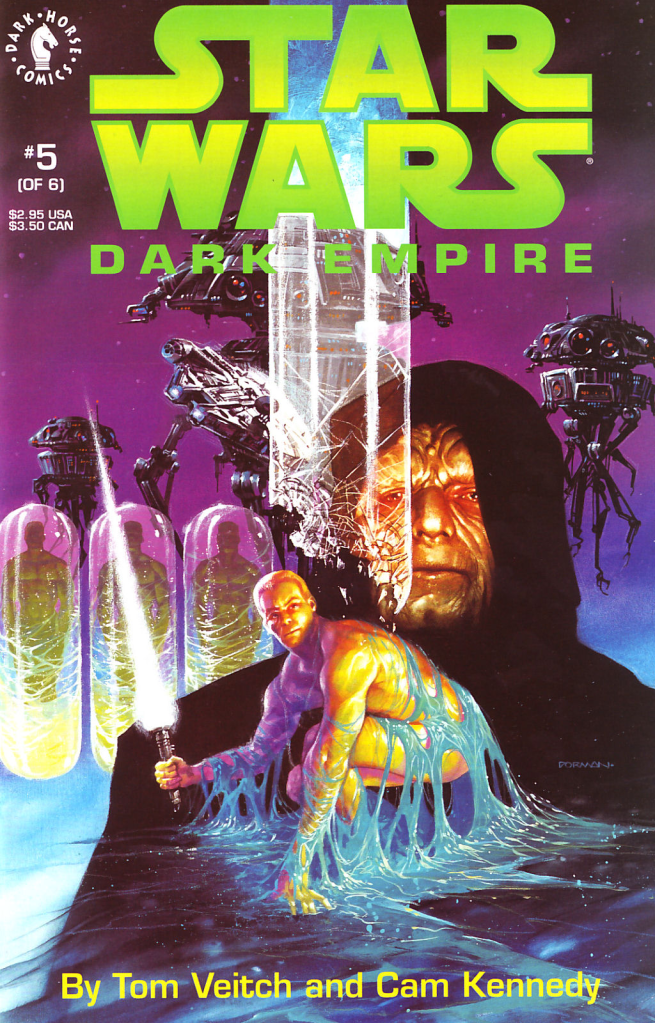
Then there’s that indie powerhouse that could with their glorious takes on existing franchises like Aliens, Predator, The Terminator, Star Wars and later, Hellboy, Umbrella Academy, The Mask, Buffy the Vampire Slayer, Ninja Gaiden and 300. Before Marvel retained their publication rights to Star Wars (and now claiming Aliens and Predator), The Force was breathing for years indie-style. Tom Veitch and Cam Kennedy’s two Dark Empire miniseries remain longtime fan favorites and should be considered canon, in my opinion, along with Timothy Zahn’s Heir to the Empire and Kevin J. Anderson’s Jedi Academy novel trilogies.
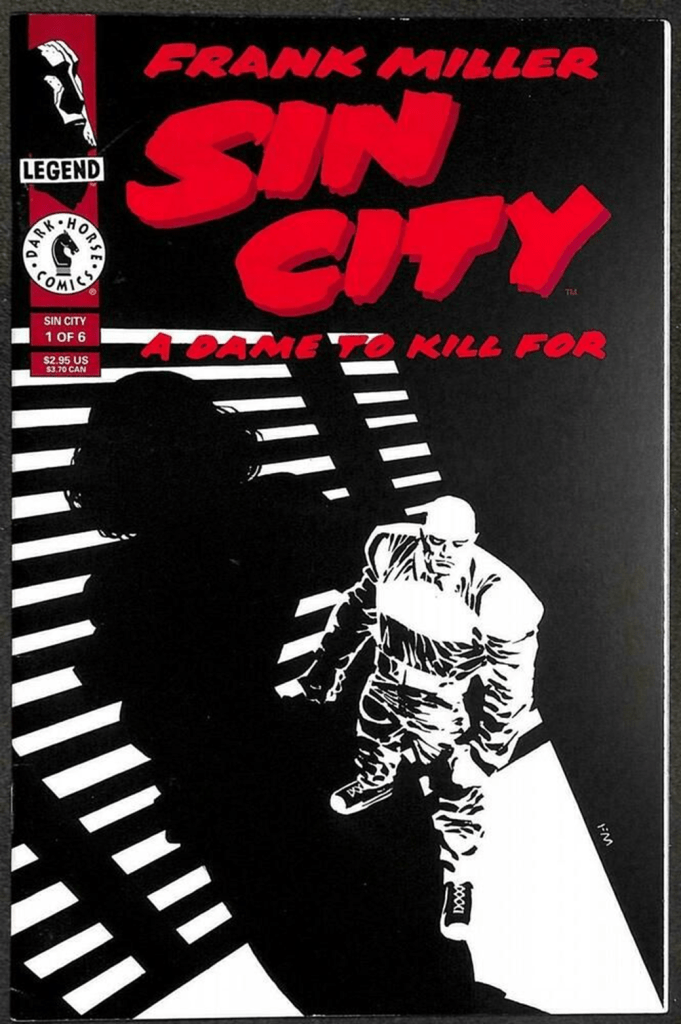
I’m talking Dark Horse Comics, the same house which ushered a sick and twisted redefinition of pulp noir with Frank Miller’s timeless Sin City. Like Image, Dark Horse launched their own brand of in-house superheroes as “Comics’ Greatest World,” which both caught on and flopped in the 1990s (though the label officially began in 1986), with X, Ghost and Barb Wire, the latter made into an atrocious action flick starring Pamela Anderson. Back in the day, their monthly anthology Dark Horse Presents was one to look forward to, mingling short comic stories between franchise-driven and original material.
It’ll take more than your constitution for me to further illustrate a historical outline of comic books, especially independent presses going as far back as Charlton, Gold Key and Eclipse to the newer brigade of Dynamite, Oni Press, Valiant, Scout Comics, IDW, Boom! Studios, Titan Comics, Top Cow and Vault Comics. Suffice it to say, there’s a plethora of independent publishers. Chances are, that new favorite outlandish, gangbusters movie or streaming show that’s become your new addiction is based off an indie comic. The Boys, need I say more? Only in reminder to never forget the zombie phenomenon of The Walking Dead began as an independently released comic, much as HBO’s intelligent response, The Last of Us, comes courtesy of the gaming world.
Spinning back, of course to Image, who are credited as renaissance kings for publishing original creator content. Here is a home where the writing and art gunslingers at Marvel and DC are pushing their own characters and series outside of the superhero realm. Though you’ll get some of those with Image as well, with a decided thumb bite from writers like Mark Millar and Tim Seeley. Millar has given us spectacular crossover hero legacies which you’ve seen in film via Kick-Ass, Wanted, Jupiter’s Legacy and The Kingsman, along with many other staple titles like Huck, Reborn, Hit Girl and American Jesus. It’s so vast, he’s now shaking his entire Millarworld up in a brutal free-for-all miniseries, Big Game.
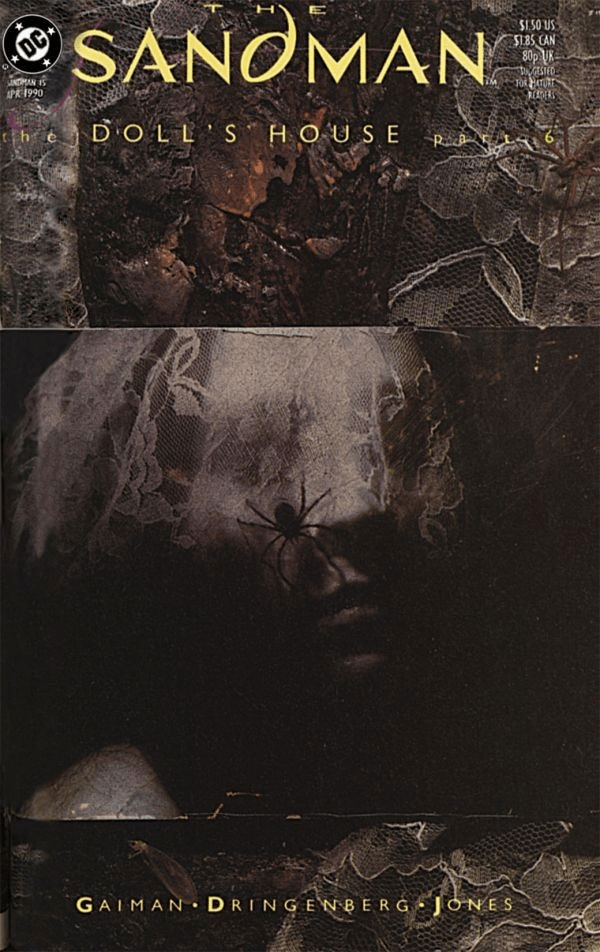
I would be remiss without stating both DC and Marvel have made their attempts to popularize fringe material outside of their realms of super. Marvel once had Epic Comics, which leaned more towards hard sci-fi and otherworldly fantasy in the vein of Heavy Metal magazine. Anyone with a serious love of comics is already hollering “Vertigo!” at me, DC’s mature audiences side brand which, for me, saved comics in the Nineties via The Sandman, Hellblazer, Swamp Thing, V is for Vendetta, Preacher, Fables, Kid Eternity, 100 Bullets, American Vampire, Codename: Knockout, Lucifer, Scalped, Shade: The Changing Man and Punk Rock Jesus. Seriously, without Vertigo and Image, the independent comic would be the same as independent politicians; on the outs, no prayer of an outreach beyond a minor demographic nobody gives much cred. DC even gave Joe Hill (yeah, that Joe Hill) a stab at launching his own stable, Hill House Horror, and some damned intriguing miniseries emerged like Basketful of Heads, Daphne Byrne, Plunge and The Low, Low Woods outside of his acclaimed Locke & Key.
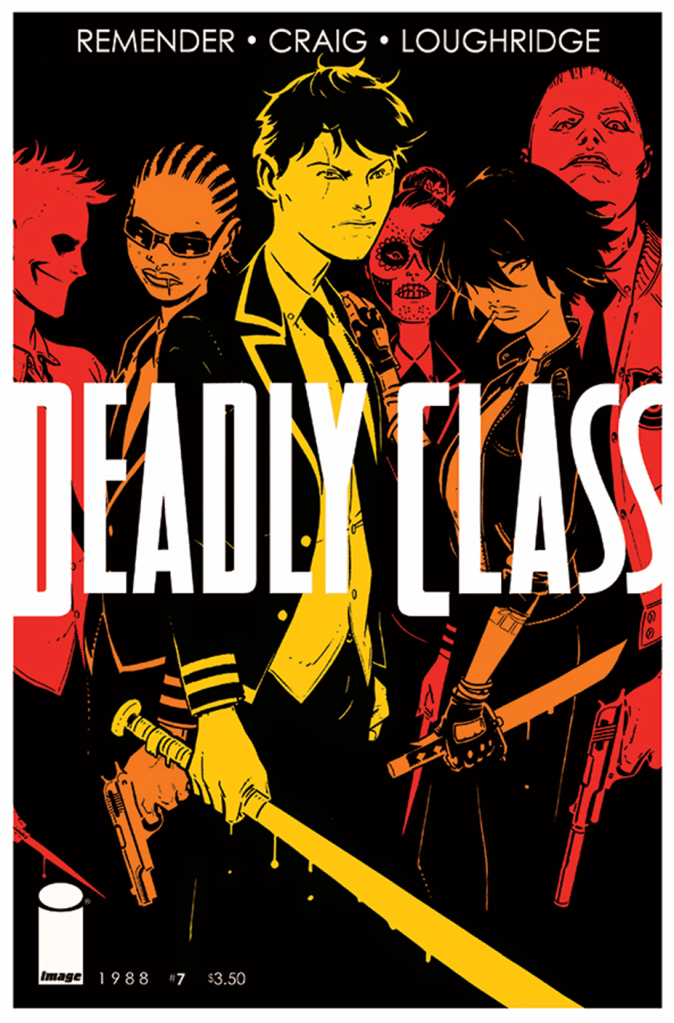
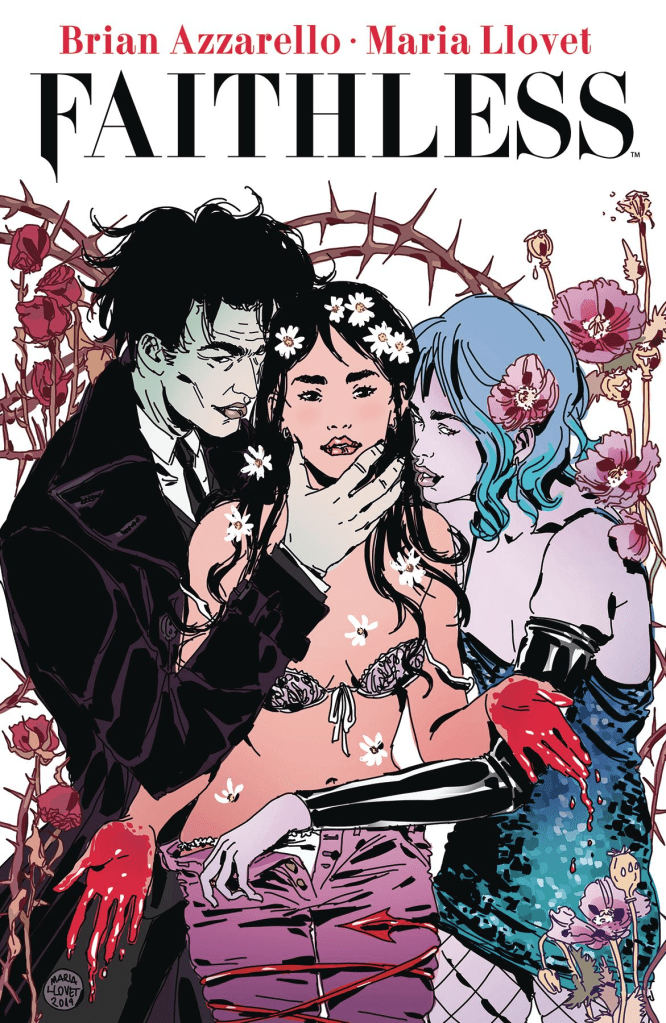
Deadly Class is one of comics’ instant classics which recently completed its run and had a brief fling as an adapted show on Syfy. Rick Remender said everything I ever felt, as a teenager and as a metal-punk hybrid, mostly metalhead. Though I never wanted an outlet for my anger as to join a school of assassins where the stakes are, indeed deadly. For all the comic books that have pushed taboos like Ferals, Faust, The Divine + the Wicked, Sex, Faithless and Sex Criminals, it’s Deadly Class and Brian K. Vaughan/Fiona Staples’ Dali gone intergalactic masterwork, Saga (probably the greatest indie comic of all-time) which showed me the true power of independent comics storytelling.
I like to say there’s a comic book for everyone out there and if you’re new and curious to the medium, by all means, dive in to The Big Two’s offerings, even with the rising cover prices. I’ll admit DC’s pricing has gone so wonky lately I had to purge many of their books off my pull list (as a major Batman and Batgirl fan I just can’t keep up, expense-wise), though Tom King just rebooted Wonder Woman last week with one of the most jaw-dropping plots in the Amazonian princess’ entire 80-plus year run. Tom King is like the horror mogul bearing the same last name, both inarguable masters of their craft. What Tom King has done on Batman, Mister Miracle, Heroes in Crisis, Strange Adventures and Batman/Catwoman is high literature. Marvel, I’m always swimming around in Black Panther, Moon Knight, Daredevil, Captain America, Thor, Captain Marvel, the X-Men books, Spidey and many others. I’m a lifer comics hound, so yeah, my collection is dominated by The Big Two.
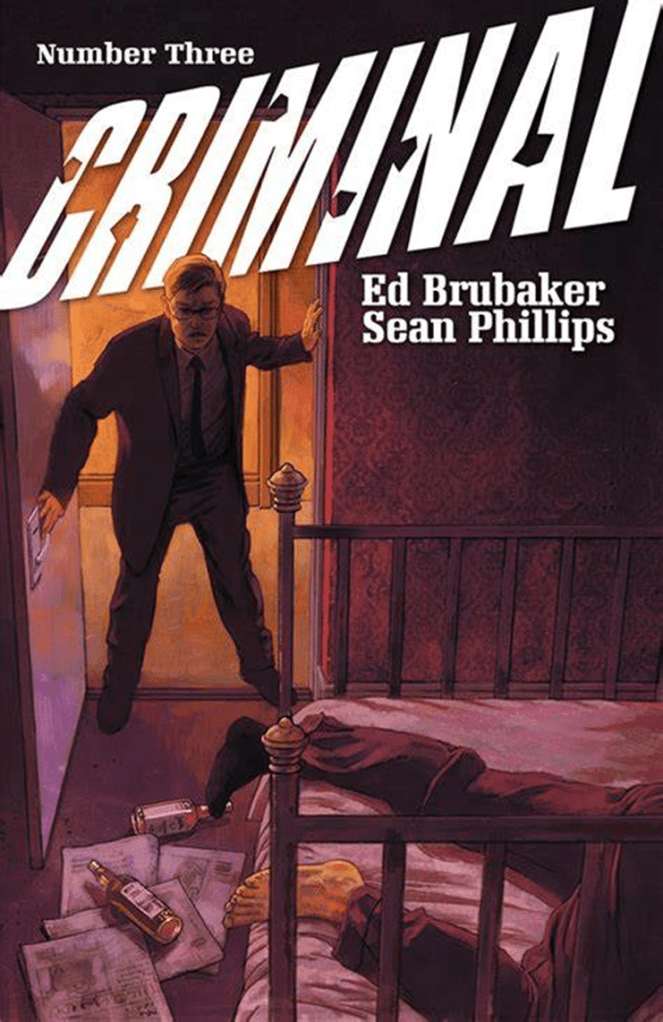
I can rattle off a score of recommended independent comic series like Low, Nailbiter, Paper Girls, I Hate Fairyland, The Very Last Final Girls, Charm City, Local Man, Invincible, Red Sonja, Vampirella, Fatale, Chew, Indigo Children, Astro City, The Red Mother, Criminal, Grindhouse, Rai, Bloodshot, Witchblade, East of West, Black Science, Revival, The Girl With the Dragon Tattoo, Kill or Be Killed, Wytches, Lumberjanes and damned near anything written by Ed Brubaker, Kelly Thompson (who writes the snappiest banter in comics, bar none) or James Tynion, IV, the latter of whom I will get to in a moment.
Even Archie comics have undergone transformation and reimagined in other domains, such as the modernized rebranding of the main Archie series as precursor to the Riverdale t.v. series. Then there’s the nutty but fun Archie Meets Kiss,Archie Meets the Ramones and the gleefully gonzo mash-up, Archie Meets Predator. Imagine, if you will, a clownish alterverse where Betty and Veronica have a 12-issue run-in with, of all things, Red Sonja and Vampirella. It happened. None of these shenanigans outshine the outstanding horror romp, Afterlife With Archie and its malevolent sister series The Chilling Adventures of Sabrina, the latter being far more sinister than its live action Netflix interpretation. It’s a damn shame Roberto Aguirre-Sacasa got redirected with writing t.v. scripts and had to abandon these gems. I’m still holding out for their resurrections.
Here are a few more independent titles I’m flipped out for:
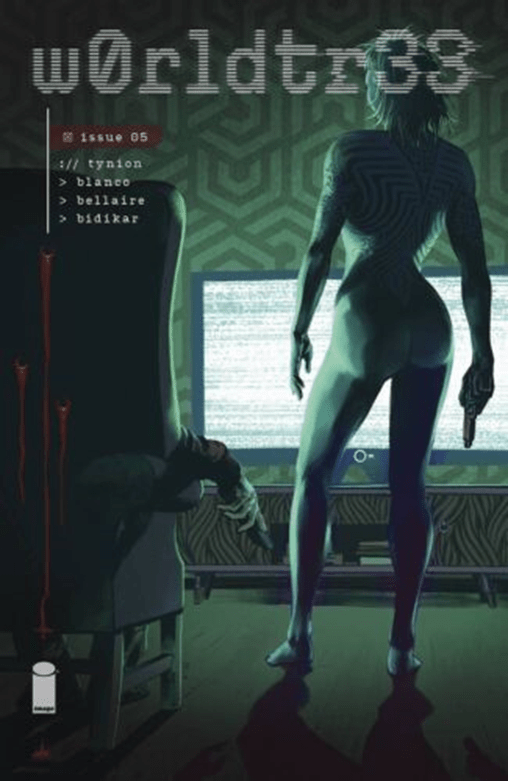
As I mentioned earlier, James Tynion IV is fire. I sat in on one of his convention panels for Boom! Comics and was happy I could contribute something he liked to the conversation. I came to Tynion’s work through the Bat comics and was blown away then. I heard so much talk in comic shops and online about The Woods, I couldn’t help but check it out. I came home from the same convention with the first seven trade paperback collections and went to the finish line. High school horror like you’ve never seen. I can’t spoil it by talking about it. Sheer genius. Then there’s Something is Killing the Children, one of the best horror comics of the modern age. Tynion’s fantasy epic, Wynd, is out of the norm for his regular work, but beautiful stuff. He recently did a 12-issue arc for DC, The Nice House on the Lake, which seems destined to continue, but holy shitballs, Tynion’s newest series for Image, W0rldtr33 is probably indie comics’ hottest ticket right now. Screw the dark web; Tynion’s Undernet is where the apocalypse will be staked. Each issue has gone to multiple printings, the debut issue already on its fifth.
My grandfather used to devour pulp, crime, military merc and western novels as I did by his side and in my bedroom with Stephen King and Conan the Barbarian books. Casca, Mack Bolan, Mike Hammer, Louis L’Amour were his jam and I used to sneak read some of these based on the scantilly-clad women on the covers of those bombastic, juicy paperbacks. Thus I became a fan of noir and pulp, and when you mash them together in Charles Adai’s Gun Honey universe, you get smart and sexy femme assassins who like their sex, absolutely, but tearing shit up gets their rocks off more. No doubt Adai took inspiration from G.G. Fickling’s pulp novel, A Gun for Honey, but he’s now wrapping on three miniseries under Gun Honey, which follows weapons expert Joanna Tan and now master of disguise associate Dahlia Racers in the current arc, Heat Seeker. There’s the promise of more, and I can’t wait. Adai owns the Hard Case Crime imprint, which has published one of my all-time favorite Stephen King novels, Joyland, along with The Colorado Kid and Later. Other HCC comics (in partnership with UK publisher Titan Comics) to check out are Peepland, Triggerman, Breakneck and Normandy Gold.
Let’s stay in the theme of noir and Titan Comics by flagging their Blade Runner line. Who better to thread the events between the original film and Blade Runner 2049 (regular readers of Roads Lesser Traveled know my devotion to these films) than the writer of 2049 himself, Michael Green? I can’t imagine the pressure Green must feel as he’s been writing 12-issue arcs for each decade leading up to Neander Wallace’s reign over the dystopian rape of organic life on Earth. We see and gain more sympathy for the replicant underground, who take a decisive stance through Blade Runner 2019, 2029 and now 2039, though nothing outdoes K and Joi’s sublime artificial romance onscreen in 2049 that rang deeper and truer than most human relationships. No Harrison Ford or Ryan Gosling. In this series, we follow a female Blade Runner, Aanna “Ash” Ashina, as she puts the pieces together of the fallen Tyrell Corporation on her way toward an inevitable confrontation with Niander Wallace’s “angel” replicant, Luv. Ash, considered the best Blade Runner of her time, has her own fall and learns the same level of empathy for replicant rights to co-exist as Ford’s Rick Deckard did. An impossible achievement, Michael Green deserves his own commendation to this esteemed franchise. Titan also released Blade Runner: Origins and a comic tie-in to the CGI show, Blade Runner: Black Lotus. The future is dead only in this world’s ecosystem.
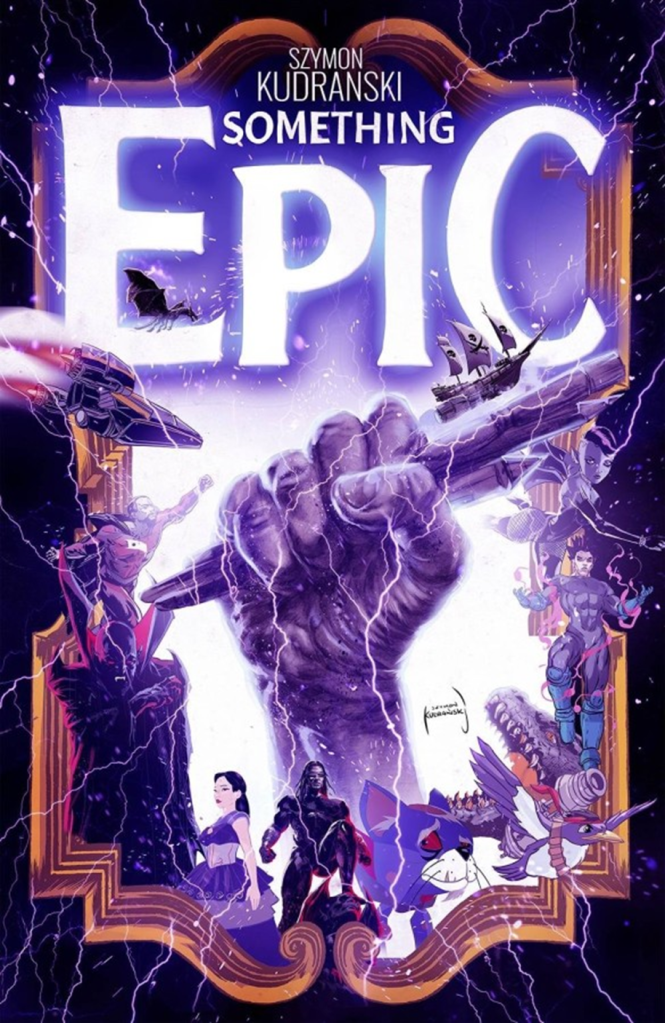
Szymon Kudranski is a wunderkind. Artist, writer, letter and colorist. All in-house and all of it supreme quality. Something Epic is possibly comics’ answer to Ready Player One in the respect pop culture or facsimiles of pop culture run rampant in this gorgeous series which already seems to have a finish line in mind, but could rival Saga if left to play longer. Danny Dillon has a gift beyond gifts. He sees an entire world nobody else does. Imagination running wild in the free world. Kudranski breaks our hearts immediately as 14-year-old Danny is about to suffer tragedy as his mother (the only human on the planet who can believe what he’s going through) is dying of cancer. The narrative bleeds and we feel every lick of Danny’s pain through Kudranski’s elegant prose. Danny is an artist beyond his years, but his adult life has further reaching ramifications. He sees superheroes, monsters, cartoon characters, ships and fire, but it all bursts from a gatekeeper second world a rare few can perceive. Something Epic is setting up for something just that, as the older Danny has faced video game-like trials to claim his rightful place finishing left-for-dead creations of imagination to give them proper life. Just beautiful.
Obviously not a road lesser traveled with the deserving blockbuster theatrical sales for the Black Panther sequel, Wakanda Forever, but I wanted to share my immediate thoughts after catching it Saturday afternoon with the fam…
I don’t say this like it’s entitlement, but I have read Black Panther comics for much of my 52 years (and still do). Enough to see Shuri take the mantle in the comics before film while T’Challa rediscovered himself filling in as Daredevil. As a Caucasian middle class kid, I delighted one of the few characters of color in comics was regal, powerful, respected, acrobatic and an off the chart genius. This when the Civil Rights Movement was still feeling its aftereffects. I know what a tough thing it was to make Wakanda Forever without the franchise’s heart and soul, Chadwick Boseman. I was one of two people who cheered his arrival out loud in the theater during Captain America: Civil War and when T’Challa came back in Avengers: Endgame, my son and I both stood up in the theater and snapped off the familiar Wakanda salute. I don’t mourn celebrity deaths often, but I did Chadwick’s. He IS and always will be the Black Panther, and as a longtime fan of T’Challa and the fictitious utopia of Wakanda, I was mostly thrilled by Wakanda Forever.
A couple minor gripes aside, this is a poignant, reverential, emotional tribute, not only to Chadwick, but to Black Panther’s creators, Stan Lee and Jack Kirby. These were two white, Jewish men who created T’Challa and Wakanda in the interest of empowering a downtrodden race. The cast for the Black Panther films have understood the meaning of legacy and ascendancy. Watching both films, I had the same recurring thought, these are no mere movies; they are the revolution Lee and Kirby propagated more than 50 years ago. Strength and honor be yours, Wakanda, forever…
For decades, fans have been polarized as to which of his dual love interests that ginger swinger, Archie Andrews, should pick, once-and-for all. In my opinion, the cad deserves neither, but for posterity purposes, which camp do you fall into?
I’m a lifelong lover of comic books, having started my infatuation with them in 1978. Following their exploits for decades, two characters burned in my mind as deserving of a broader audience beyond their cult fan status. Working in a comic book shop in the 1990s and through the mainstream hijacking of superhero films, I’ve said time and again how Black Panther and Moon Knight were worthy of comeuppance. Not merely because they are connected through a mutual goddess, Bast.
It took all the way until 2018 for Black Panther to shake the world as Stan Lee envisioned his gravity back in the 1960s. Rest in power, Chadwick Boseman. Meanwhile, Moon Knight has long been relegated to a minor tier fan favorite. Call him a deep cut of the Marvel U. The Fist of Khonshu has only recently broken through this year with Oscar Isaacs pulling off the unthinkable in a triumphant depiction of not one, but multiple lead characters in Moon Knight’s Disney Plus miniseries.
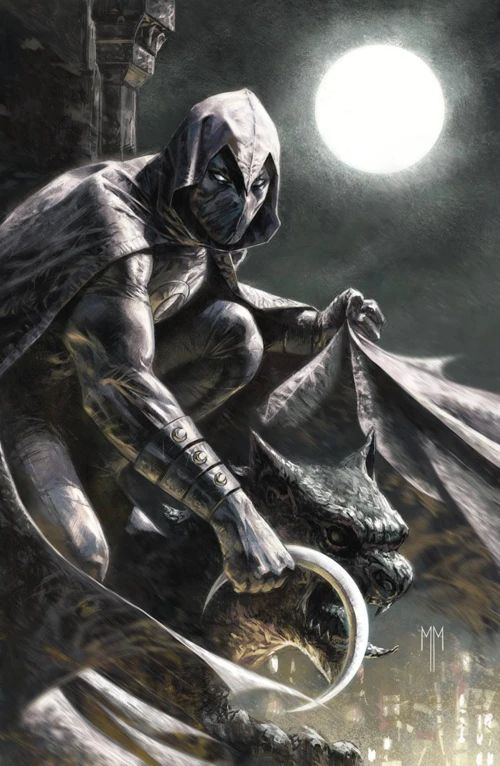
Comics-speaking, Moon Knight is the bipolar earthly avatar of the Egyptian moon god, Khonsu–written as Khonshu in the comics and t.v. show. The struggles of central human host, Marc Spector, wrestling with his dissociative personality disorder while fighting crime, has ushered some emotively compelling storytelling in recent years.
To really know Moon Knight is to understand his nuances. Marc Spector is a man of the Jewish faith fighting on behalf of Egypt. All eyes on you, Rameses II. Worse, he’s fighting his violent deeds as a mercenary forced to share head space with a proverbial cab driver (Jake Lockley), a rich socialite (Steven Grant), a masked, bruising Dapper Dan (Mr. Knight) and the shadow warrior himself.
I had a burst of inspiration after reading the latest issue of Jed Mackay’s run of Moon Knight, then chatting with my pantheon after drawing a tarot reading on myself. It was my patron warrior and healer goddess, Sekhmet, and a writer’s best buddy, Thoth, who nudged me to generate a tongue-in-cheek piece, thrusting Marc Spector into an even weirder “What if?” scenario than usually comes out of The House of Ideas…
When Moon Knight Cheated on Khonshu with Sekhmet…
THE SCENE: In the Manhattan apartment of Marc Spector, aka Moon Knight, aka Mr. Knight, aka Steven Grant, aka Jake Lockley. Spector and his various personae are leafing through a photo album of Spector’s childhood years. Spector is drinking a glass of deep red and holding his head like he has the mother of all hangovers. It’s only 1:36 a.m. His fists are raw and already scabbing from the night’s activities when his patron lunar god, Khonshu makes an unexpected appearance…
Khonshu: “My son…”
Marc Spector: “Yeah? Oh, great, it’s you.”
Moon Knight: “What is your bidding, my Lord?”
Jake Lockley: “Yo!”
Mr. Knight: “Shit, I have a wine stain on my tie. What, is it Mercury Retrograde again already? You would have to pick tonight for one of your edification sessions, Khonshu.”
Jake Lockley: “That’s what you get for wearing an entire suit of white all the time, Snowball.”
Steven Grant: “Don’t sweat the small stuff. I’m a regular at Lemire’s Cleaners down on Pinehurst and 54th. Tell them I said to take care of you and put it on my account.”
Khonshu: “Sigh…Thoth help me… My son, I had a disturbing chat with Sekhmet moments ago…”
Mr. Knight: “2015 vintage cabernet, no less.”
Steven Grant: “How topical. I just bought a few bottles of Cabernet Franc from this vineyard outside of Cooperstown last week. I’d swear upon Ani’s writings the blackcurrants were blessed by Renenutet herself.”
Mr. Knight: “I’d bet my ruby-crusted ankh we’re talking about the same place.”
Steven Grant: “We’ve traveled the same circles, obviously.”
Jake Lockley: “Did someone mention alcohol? I’m a little dry.”
Marc Spector: “Can it, guys, I’ve got this.”
Moon Knight: “Quit posing, Spector. I do all the dirty work around here. I am the chosen one, after all.”
Mr. Knight: “Running a few merc ops without getting yourself killed will give anyone a superiority complex. Doesn’t do a Goddess-damned thing for my predicament, though. I wonder if Brioni has 24-7 customer service.”
Jake Lockley: “Primadonna.”
Khonshu: “Grrrr, and I thought the Fifth Dynasty were full of themselves… Getting to the matter at-hand, I am informed you may have been colluding with the cat goddess…”
Mr. Knight: “Bastet has the most exquisite tailoring, and she gives hella good cat scratch fever.”
Jake Lockley: “You wish, Desmond Merrion.”
Khonshu: “Quiet! Again, I am referring to Sekhmet. A tryst is said to have occurred only hours ago.”
Jake Lockley: “Don’t look at me, man. I was taking a fare to the Gaga show at the Garden. Some fat cat high roller who tips like crap. Which is to say, not all.”
Stephen Grant: “That was me, you idiot! And Misty Knight, whom you had the gall to blow her cover bringing up that Daughters of Liberty gig anyone in our racket knows is on the down low. Also on the no-discuss list, she’s been clipping the wings of Captain America lately. Not Rogers, the Wilson guy. Both my Cap, for the record. Yes, I’m rambling.”
Mr. Knight: “Of all the… Misty was supposed to be my date. Well, if you consider a night of binging Ancient Aliens with my famous lime-drizzled fish tacos and guac loaded with ghost peppers an actual date. Here I thought we had a connection with the name thing…”
Khonshu: “Enough of this confounded prattling! This is what I get for taking on a five-for-one avatar. Horus, take me now. Anywhere.”
Jake Lockley: “The Deftones are playing the Stone Pony in Asbury tomorrow. Just saying.”
Moon Knight: “My Lord, the details are cloudy, but I do recall running into Sekhmet on the astral plane. I was summoned by Anubis to meditate after I knocked the teeth out of this worm dung trying to jump an old lady down in the Garment District. Anubis advised I may have used a bit of excessive force. That’s when I seem to remember Sekhmet interjecting.”
Khonshu: “You mean exchanging energies, the polite way of putting things, my once-loyal embodiment. Sekhmet is not easily appeased, fair warning.”
Moon Knight: “I don’t know what you’re getting at, my Lord, but Sekhmet approved of the brutalizing. In fact, she offered to sanction me to the Council. We have chimera to thwart, plus vampires, renegade griffin, those K’un-Lun rejects calling themselves the Red Right Hands, skin walkers dressed like Amazon Prime drivers, even unholy Apep once a week.”
Jake Lockley: “Apep’s become such a slacker.”
Marc Spector: “So that’s why I wanted a steak so bad tonight. I’m not usually a cravings kind of guy and I take my meat cooked medium. This one was done rare, and I ate it in minutes, even without A-1. I never eat a steak without A-1. Something’s shady.”
Moon Knight: “Yes, Sekhmet mentioned the steak. She was offended you never gave her an offering, Spector. It was bone-in ribeye, what were you thinking? Sekhmet says it’s possible to stay in her graces by leaving a pint of Guinness milk stout at her ka statue in Migdol. Her consort, Lord Ptah, also requests an homage paid in beer, though he prefers an IPA. Or a summer wheat. He’s less picky.”
Jake Lockley: “IPA? There’s just no accounting for taste, even amongst the gods.”
Marc Spector: “In Egypt? Are you insane, Moon Knight?”
Steven Grant: “That’s speculative.”
Mr. Knight: “Define insane.”
Jake Lockley: “Insane is drinking IPA.”
Moon Knight: “My ba and my akh need serious modification before the Maat Kheru ever takes place. Ammit the Devourer will eat me before the scales ever pass judgment at this point.”
Khonshu: “Need I remind you, Spector, with great power comes…”
Steven Grant: “Careful, great Lord, I smell infringement.”
Marc Spector: “I heard the same spiel from that Parker kid a year ago. You see where ethics gets him in this city.”
Khonshu: “Sigh…there’s hardly enough opium in Saqqara to put up with… Tread carefully, Marc Spector. I can take that which I have given.”
Marc Spector: “Why is this always about me, for Christ’s sake?”
Jake Lockley: “Aww, now you’ve done it, bringing up His name… Get me my yarmulke, quick. Is tomorrow Saturday, by chance?”
Mr. Knight: “Now am I right to insinuate that you…or, rather, we, were shaking sheets with The Mistress of Dread earlier tonight? If so, one, I wish I remembered it. Two, is Ptah pissed off? I’m in the middle of building a wooden bird feeder for all the robins which keep showing up. They pound seed like Lockley does a rum runner…or six.”
Jake Lockley: “Eff you, Snowball.”
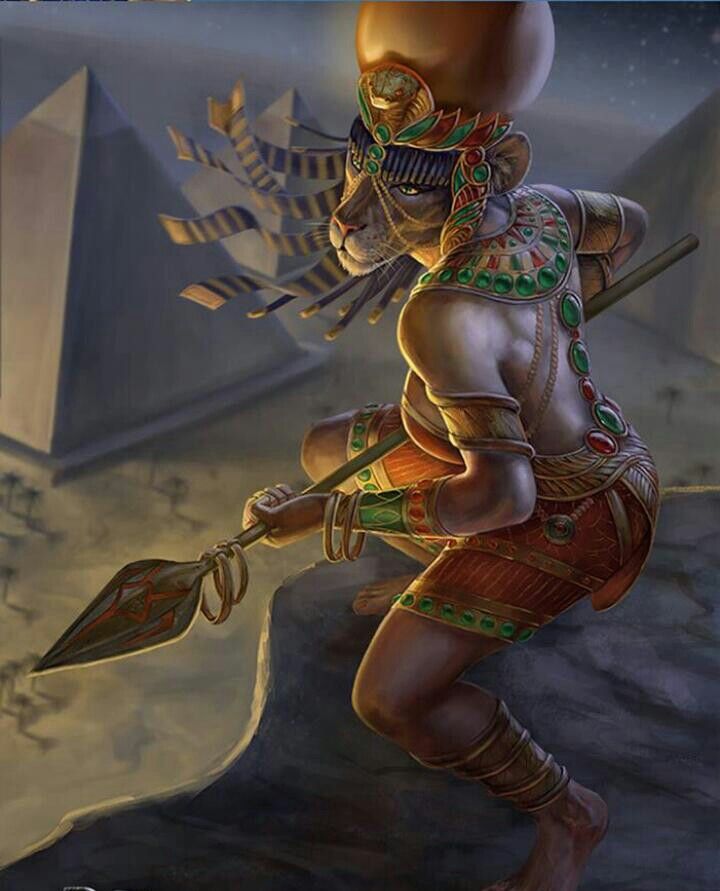
Mr. Knight: “Three, if you’re doing it with something that’s human in body and a lioness in the head, is that still considered bestiality?”
Khonshu: “Set, I just know this is your doing…”
Moon Knight and all his images and various personae are owned by Marvel Comics.
This farce is written with longtime love and respect for the multifaceted world of Marc Spector, along with his chroniclers and devotion to an Egyptian pantheon which prodded Ray Van Horn, Jr. to roast at their expense. Blessed be…
I scoffed at it. I resisted it. I’ve worked comic book retail before. I know what this is. It’s festering shtick played for cheap. If you can finger snap beloved characters gone, you can expect most, if not all of them to return once the profit margin begs for it.
Granted, for sheer curiosity, I opened the blazoned summoning to “Death of the Justice League” a couple times two different Wednesdays on new book day. I even made the rare faux pas of lingering on the end pages because I just know better.
The generous bundle of copies remaining on the shelves two months after the book’s release was a strong indicator. Albeit, they were the standard cover copies, and not the variants and certainly not the glossy acetate packaging. The latter hung about the comic book shop I frequent for a few weeks before selling out. Out of nowhere, though, perhaps from a closed down pull box or another customer unable to clear out weekly held books in suitable fashion, an acetate cover copy manifested.
Add to my conundrum of being baited a Father’s Day gift certificate from my loving fiancée, and with it the freedom to try books I’ve passed on in the interest of saving money. Well… To the good, I was able to score the first three issues of Keiron Gillen’s brilliant Immortal X-Men plus the riotous and gory hijacking of Wolverine # 20-22 by Logan’s smart-assed, likewise indestructible foil, Deadpool. Best ‘pool writing I’ve seen in the past few years.
Damnation, I wasn’t going to play ball, but that acetate cover of Justice League # 75 was coming down the line at me like a routine groundout at first, the ninth inning with the winning run on third. By the time I read the thing, it’s exactly the way I felt about it. Good contact, sharply driven, but in the end, a blasé out to flub a game-ending rally. No walk-off. Extra innings toward an indecisive outcome.
Yes, I know all the marketing gimmicks and presentation tricks from comic book publishers. When I worked in a comic shop in the early 1990s called Alternate Worlds, we sold tons of books cased in sealed polymer bags, along with special covers done in gatefolds, tri-folds, prism 3-D designs, holograms, a plastic diamond angle (looking at and from you, Eclipso), die-cut embossing, chrome plating, you name it. Ask collectors who were there; the smoke and mirrors work favored by the publishers were masking mediocre to miserable material inside.
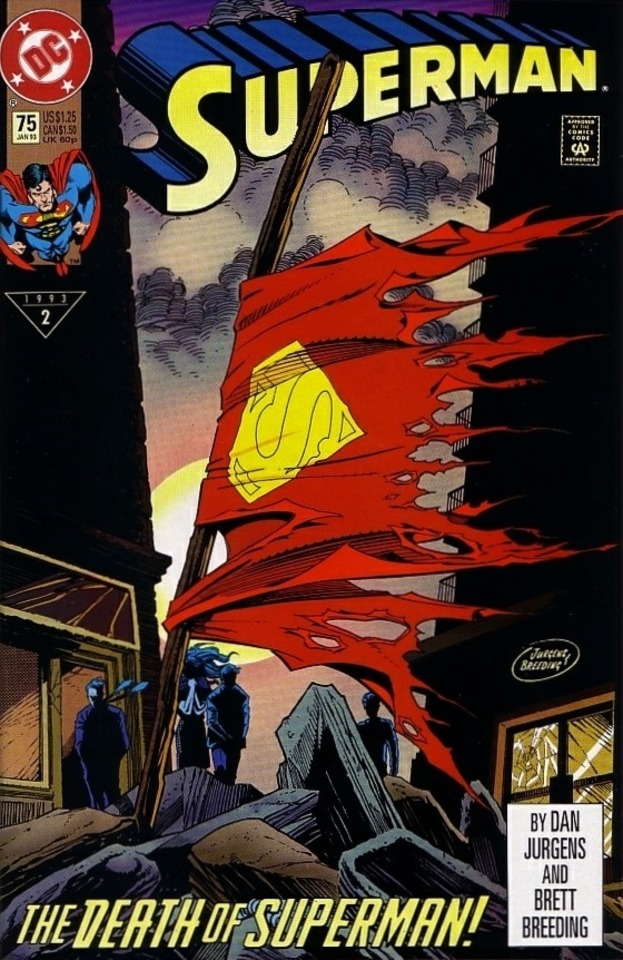
From this time period, I’m currently writing a fiction story based on my experiences in comics retail. Specifically, the notorious Death of Superman (or “Doomsday”) and Funeral for a Friend saga spanning from 1992 to 1993. If anything reeked of cash grab in the comics industry, it was this bald-faced ploy to knock off The Man of Steel, who had me and maybe 30 other readers nationwide at the time. To be a part of that shocking and momentous occasion was to understand public duping at its best. Most of the people who bought Superman # 75 and the entire Doomsday story arc, as it was largely sold to consumers plunking down a deposit toward the entire run over Supes’ four titles (and Justice League of America # 69) at the time, weren’t even comic book readers. They were investors looking to nab a slice of history it seemed would never repeat itself, save for the four print runs of the pivotal “death” issue.
As their rival imprint’s “distinguished competition,” DC Comics have been no strangers to running the death gambit with their flagship characters. What was originally mortifying and tragic in 1985 when the original Flash, Barry Allen, and Supergirl, were purportedly snuffed in the Crisis on Infinite Earths miniseries, has now become more of an asterisk instead of an exclamation point. DC and Marvel have killed and resurrected their stable so many times now it’s not even liberally covered under a pervading “multiverse” clause. It’s become Mandolorian-esque: This is the way.
Marvel has ingeniously staked a godhead factor within its still-building Krakoa era of their X-Men titles. The mutant sovereignty has discovered the method toward regenerating their entire population as needs and Quiet Council decrees must. As if Wolverine hasn’t died enough times, or lest we’ve suffered the perversion of resurrecting decades-dead Gwen Stacy, rebranded as hybrid avatars of Marvel’s long-standing cast (i.e. Gwenpool and Spider-Gwen). Marvel can now slaughter mutants at wholesale and bring them back within a single issue. Skip the emotive funeral aftermath tie-in.
For all my blustering, you can bet that acetate covered Justice League # 75 came along with me. All of my knowledge and background in marketing, yep, I still caved when I saw an acetate version of the book re-emerge on the shelf and I had a gift cert to burn. Yes, the confounded acetate cover is cool-looking. You got me this time, DC, drat it.
The book’s been out a while, and everyone who cares about this stuff knows what you see with the comic carny huckstering is what you get with Justice League # 75. Is it any surprise this comes at an issue numbered 75, for all intents and purposes, Superman’s new kryptonite?
Save for Green Arrow’s part in it, however, this is the most pedestrian fall of comic titans I’ve ever read. I’ve been at comics reading for more than four decades, and I have a strong suspicion what Joshua Williamson and DC is up to by creating a minimalist finale to the title’s current run. We all do, considering it’s all precursor to the publisher’s upcoming Dark Crisis crossover. I can make a prediction what this has all been for, which, on the face isn’t much other than to see The Spectre swing sides and Jon Stewart’s valiant stint as lead Green Lantern nearly save the day.
In the end, oblivion rules over Justice League # 75 in the same shredding fashion as the heroes died in Crisis on Infinite Earths, which is my main gripe to the whole thing. Wonder Woman only just recently cheated death a few months ago for what, the fourth time? Now this? Not even Krakoa’s cloning prowess, assuming it could be loaned ad hoc across competitor lines, can handle this in-and-out genetic reassembly like Sylvester McMonkey McBean’s star brands on (and off) thars. Alfred Pennyworth’s death being the only in comics to have any reticence and gravity, much less sticking power these days.
Which is what this constant die-in, die-out motif in comics feels like: a sham unfurled with just one suckering lever pull. Pointless variant covers and wearying reboots of comic series back to Issue 1 ad infinitum being enough excuse to just let the super bodies hit the floor.


















 Roads Lesser Traveled